09 Nov 2023
ESG in shipping is often discussed while a vessel is still trading: emissions, fuel efficiency, crew welfare, financing, reporting and governance. Yet one of the clearest tests of those commitments can come at the very end of the vessel’s operating life.
Ship recycling brings environmental, social and governance issues together in a way that is unusually tangible. Hazardous materials have to be identified and managed. Workers have to dismantle a complex industrial asset safely. A suitable recycling facility has to be selected. Regulatory requirements have to be followed. Waste streams have to be controlled. Valuable materials have to return to productive use.
This is where ESG stops being an abstract corporate statement and becomes something that can be observed, documented and assessed.
When this article was first published in 2023, the central argument was that ship recycling should not be treated as an activity sitting outside a company’s wider ESG framework. That principle remains valid. What has changed is the operating and regulatory environment around it.
The Hong Kong Convention is now in force, recycling facilities across the major markets have continued to develop, and expectations around transparency, traceability and circularity are becoming more detailed.
The question is therefore no longer simply whether ship recycling belongs within ESG.
It is what credible ESG looks like when a vessel reaches the end of its operating life.
A vessel is monitored throughout its operating life through class, flag, insurance, technical management, surveys, maintenance records and regulatory requirements.
Its final stage deserves the same level of attention.
The decision to recycle a vessel transfers the asset into a very different operating environment, but it does not remove the environmental, safety or governance responsibilities associated with it.
In many respects, recycling is where those responsibilities become easier to measure.
The hazardous materials onboard can be identified.
The recycling facility can be assessed.
The dismantling process can be planned.
Worker-safety measures can be observed.
Waste streams can be documented.
Recycling progress can be monitored.
The materials recovered from the vessel can increasingly be traced into their next use.
This is why responsible ship recycling should form part of lifecycle ESG rather than being treated only as an end-of-life disposal decision.
The environmental element of ship recycling starts well before the first section of steel is cut.
A properly maintained Inventory of Hazardous Materials (IHM) provides critical information about hazardous materials contained in the vessel. At the end-of-life stage, this information supports the preparation for recycling and the management of materials that require particular handling.
The IHM, however, is only one part of the environmental picture.
Environmental performance also depends on what happens inside the selected facility.
Hazardous materials need to be identified, segregated, stored and transferred appropriately. Waste-management arrangements matter. Pollution-prevention measures matter. Facility infrastructure matters. Downstream disposal and treatment routes matter.
This distinction is important because a certificate or document can establish that a system exists, but ESG performance ultimately depends on implementation.
The same principle applies to the recycling facility itself.
A facility should not be judged only by its location or by a broad description of the recycling method. What matters is the capability of the individual facility, the controls it has in place and how effectively those controls are implemented.
Environmental performance therefore requires evidence rather than assumption.
Ship recycling remains a labour-intensive industrial activity. Cutting, lifting, confined-space work, material handling and the management of hazardous substances can all create significant risks if work is not properly planned and controlled.
The social component of ESG cannot therefore be separated from worker safety.
Training is an important part of that responsibility, but training has to extend beyond completing a course.
The effectiveness of a safety system becomes visible in daily operations: whether personal protective equipment is used correctly, whether hot work is properly controlled, whether confined spaces are assessed before entry, whether lifting operations are planned, whether workers understand the hazards associated with their tasks, and whether unsafe conditions can be identified and addressed.
Communication also matters.
Ship recycling workforces may include people from different regions, languages and educational backgrounds. Safety instructions that exist only in a procedure are of limited value if the person carrying out the task does not clearly understand them.
Local-language communication, demonstrations, pictures, toolbox talks and repeated safety awareness can therefore be as important as formal written procedures.
This is one of the areas where the practical implementation of ESG can be seen most clearly.
A social policy may exist at corporate level, but its credibility at the recycling stage depends on what happens to the people carrying out the work.
Governance is sometimes the least visible part of ESG, but in ship recycling it may be one of the most important.
Good governance should make it possible to understand how the recycling decision was made and how the process was controlled.
Why was a particular facility selected?
What regulations applied to the vessel?
Was the IHM suitable for the recycling stage?
Was the facility capable of handling the vessel and its identified hazards?
Was the Ship Recycling Plan reviewed?
Who monitored the recycling process?
How were deviations or concerns handled?
What documentation remained when recycling was complete?
These are governance questions because they establish accountability.
A responsible process should leave a clear decision trail rather than simply a final statement that a vessel has been recycled.
This is where independent or structured compliance monitoring can add value. Monitoring does not replace the obligations of the shipowner, facility, flag State or recycling State. It can, however, provide a more complete record of how agreed requirements were implemented throughout the recycling process.
Good governance makes the end-of-life journey explainable.
One of the most important changes since the original version of this article is that the Hong Kong International Convention for the Safe and Environmentally Sound Recycling of Ships entered into force on 26 June 2025.
The Convention establishes an international framework covering the preparation of ships for recycling, the operation of ship recycling facilities, authorization, certification, reporting and the protection of human health and the environment.
That is a major development for the industry.
But regulatory compliance and ESG should not be treated as identical concepts.
The Convention establishes the framework. The quality of implementation still matters.
A facility may have the required systems and documentation, but the relevant ESG question remains how those systems perform during actual recycling.
Are procedures followed?
Are workers able to understand and apply them?
Are hazardous materials managed correctly?
Are downstream waste routes documented?
Are incidents, deviations and corrective actions recorded?
Does the final documentation provide a reliable account of what happened?
This is why the entry into force of HKC should strengthen ESG assessment rather than make it unnecessary.
The regulatory baseline has become clearer. The quality of execution remains critical. IMO confirms that the HKC entered into force on 26 June 2025 and covers the preparation of ships, facility operations, authorization, certification and reporting.
Ship recycling is frequently described as part of the circular economy, and there is good reason for that.
A large proportion of a vessel consists of materials that can return to productive use after dismantling. Steel, machinery, non-ferrous metals and equipment can all retain value beyond the operating life of the ship.
But circularity should not be measured only by stating that material was recycled.
A more useful question is what happens next.
How much material is reused?
How much steel is re-rolled?
How much enters a melting route?
What processing is required?
Where does the recovered material eventually go?
This is an area where ship recycling still has room to develop.
GMS has recently raised the question of whether more information could follow recovered ship steel after dismantling. One possible concept is a Ship-Recycled Steel Passport, which could connect selected batches of recovered steel with information such as the vessel of origin, recycling facility, processing route, testing and downstream application.
This is not being proposed as another mandatory international standard.
It is an idea worth exploring because the industry already spends considerable effort tracing hazardous materials through the recycling process. There may also be value in improving the traceability of the useful material recovered from the vessel.
Circularity becomes more credible when the material journey can be demonstrated rather than assumed.
GMS's recent steel-traceability article develops this concept further, including the exploratory Ship-Recycled Steel Passport idea.
Responsible recycling is sometimes presented as though environmental and social performance must sit on one side of the decision and commercial value on the other.
That is an unnecessary division.
An end-of-life vessel remains an asset with residual value.
Steel prices matter.
Currency movements matter.
Local demand matters.
Yard capacity matters.
The vessel's location matters.
Its equipment and non-ferrous content may matter.
Financing, payment security, sanctions exposure and transaction certainty may all affect the final commercial outcome.
These are legitimate parts of the recycling decision.
ESG does not require commercial considerations to disappear.
It requires environmental, social and governance factors to become part of the same decision-making process.
A high recycling price has limited value if the selected facility cannot meet the requirements applicable to the vessel.
Equally, responsible recycling should not be interpreted as an argument that commercial value no longer matters.
The stronger approach is to understand both sides of the transaction and determine whether value can be realised within an acceptable environmental, safety and governance framework.
One of the persistent difficulties in ship recycling is the tendency to use geography as a shortcut for performance.
A recycling destination is sometimes assumed to be responsible or irresponsible based largely on where it is located or the recycling method traditionally associated with that country.
That can obscure the more important questions.
What is the capability of the particular facility?
What infrastructure exists?
How are workers trained and protected?
How are hazardous materials managed?
Where do wastes go?
What monitoring takes place?
What records are maintained?
How does the facility perform during the recycling of the actual vessel?
Facilities within the same country can differ significantly.
The ESG assessment should therefore focus on evidence at facility level rather than treating geography as the conclusion.
This is also important commercially. Different vessels may be suited to different recycling facilities depending on size, type, onboard materials, regulatory requirements, location and the capability of the receiving yard.
The strongest decision is based on the vessel and the facility, not on a simplified regional label.
An ESG framework becomes more useful when broad commitments can be connected to evidence.
|
ESG area |
Examples of evidence during ship recycling |
|---|---|
|
Environmental |
Maintained IHM, hazardous-material controls, waste segregation, downstream waste records, pollution-prevention measures, environmental monitoring |
|
Social |
Worker training, PPE, safe-work systems, toolbox talks, local-language communication, emergency preparedness, worker participation |
|
Governance |
Facility assessment, applicable regulatory review, Ship Recycling Plan, monitoring records, corrective actions, completion documentation |
|
Circularity |
Material recovery records, reuse and recycling routes, steel processing information and, where feasible, downstream traceability |
The exact documentation will depend on the vessel, facility and applicable regulatory regime.
The principle is more important than the format.
Claims should be capable of being supported by evidence.
That is the difference between ESG as a policy statement and ESG as an operating system.
The original argument of this article was that ship recycling should be integrated authentically into maritime ESG rather than treated as a box-ticking exercise.
That argument has become more relevant, not less.
The entry into force of the Hong Kong Convention has created a stronger international regulatory foundation for ship recycling. At the same time, expectations around worker safety, transparency, traceability and circularity continue to develop.
This creates an opportunity to make end-of-life ESG more measurable.
Responsible ship recycling should make it possible to understand why a facility was selected, how the vessel was prepared, how workers and the environment were protected, how the recycling process was monitored and what happened to the materials recovered from the ship.
That does not require every recycling decision to look identical.
It requires the decision to be defensible.
For an industry that documents a vessel throughout its operating life, there is little reason for transparency to stop when that vessel reaches its final destination.
Ship recycling should be the final chapter of the vessel's ESG story, not an activity outside it.
And the strength of that final chapter should be judged not by the sustainability language surrounding it, but by the evidence left behind.
Originally published: 09 November 2023
Last reviewed and updated: 01 October 2026
Contact Us
Ship Recycling Team
Dr. Anand Hiremath is a leading voice in sustainable ship recycling, with a strong foundation in civil and environmental engineering and more than a decade of specialised expertise in safe and environmentally sound ship recycling.
He holds a master’s degree in Environmental Engineering from IIT Guwahati and earned his PhD from IIT Bombay, where his pioneering research on the Integrated Risk Assessment Framework for Best Practices in Ship Recycling contributed to advancing safety, environmental responsibility, and structured risk management within the industry.
As Chief Executive Officer of the Sustainable Ship and Offshore Recycling Program (SSORP), Dr. Hiremath plays a key role in strengthening responsible ship recycling practices across the sector. He works closely with recycling yards to support compliance with the Hong Kong Convention (HKC) for the safe and environmentally sound recycling of ships. Under his leadership, SSORP has overseen more than 100 Inventory of Hazardous Materials (IHM) surveys and successfully supported the recycling of over 130 end-of-life vessels.
His commitment to worker safety and practical capacity-building is reflected in more than 800 free safety awareness sessions conducted at recycling yards across the Indian subcontinent, benefiting over 13,000 workers. These initiatives have helped improve awareness, hazard recognition, and safe work practices at the yard level.
Beyond his operational leadership, Dr. Hiremath contributes to the development of the next generation of ship recycling professionals as Course Director for the Lloyd’s Maritime Academy Ship Recycling course in London. His global influence extends through his involvement in major international research and improvement initiatives, including the EU-funded DIVEST project and the Green Alang Initiative, both focused on improving environmental standards and sustainability in ship recycling.
Dr. Hiremath’s work has been published in leading international scientific journals, reinforcing his position as a thought leader in the field. He is also the author of The Green Handbook: A Practical Checklist to Monitor the Safe and Environmentally Sound Recycling of Ships, a practical industry resource for monitoring responsible ship recycling practices.
His professional credentials include Lead Auditor certifications for ISO 45001 and ISO 9001, certification as a Hazmat expert, Social Auditor, Responsible Steel Auditor, and sustainability practitioner.
With his combination of technical expertise, field experience, academic contribution, and commitment to worker safety and environmental protection, Dr. Anand Hiremath remains at the forefront of the global movement toward safer, greener, and more sustainable ship recycling.
Contact Us
Ship Recycling Team
The Hong Kong Convention has now been in force for more than a year.
Before 26 June 2025, much of the industry's attention was on when the Convention would enter into force, whether recycling ...
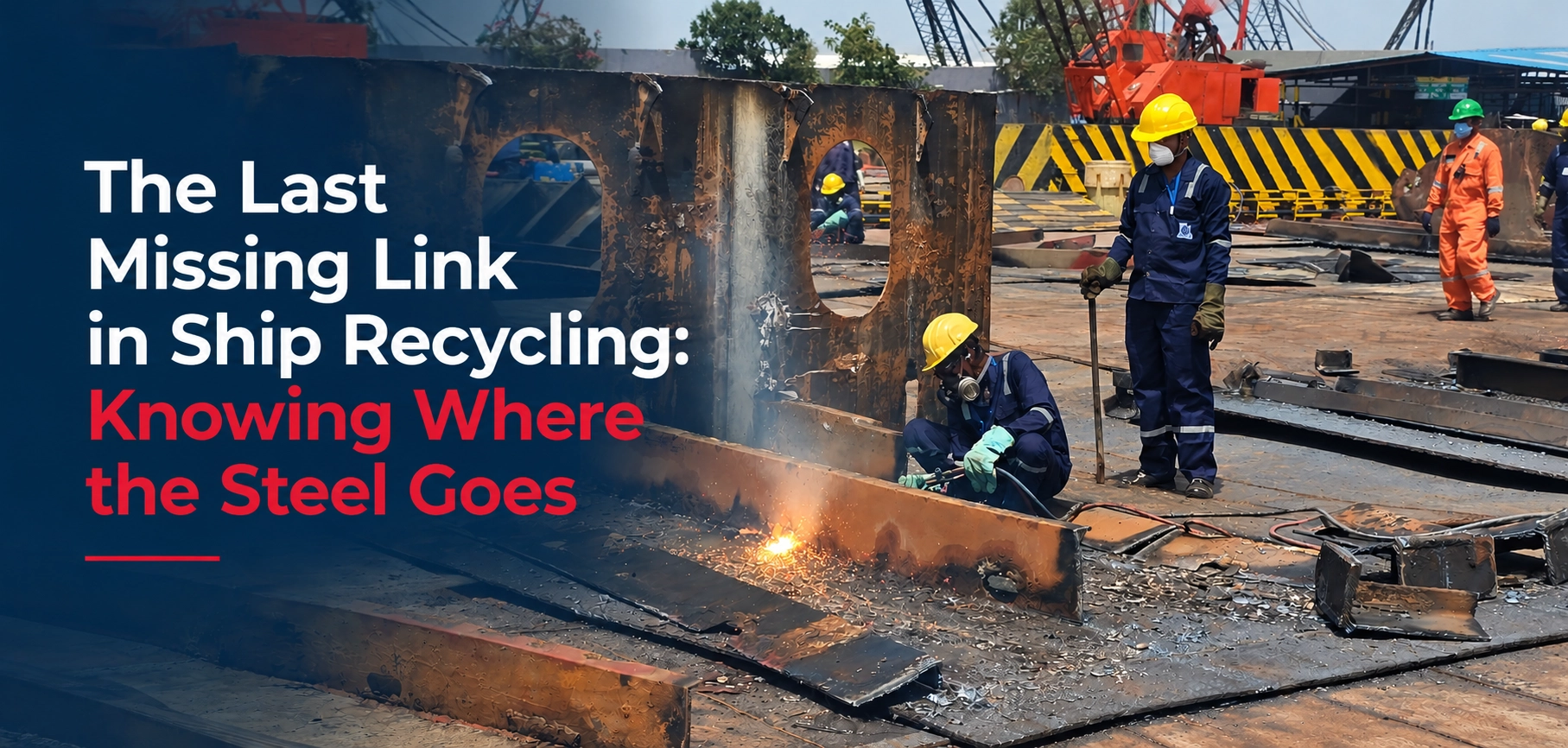
Ship recycling has developed sophisticated systems for tracing hazardous materials, but far less attention is given to tracing the steel recovered from a vessel. Dr. Anand Hiremath proposes exploring ...


Download GMS App