25 Aug 2017
The Inventory of Hazardous Materials, or IHM, is no longer something that should be prepared only when a ship approaches the end of its life. It is a ship-specific record that identifies hazardous materials contained in the vessel's structure and equipment, shows where they are located and records their approximate quantities.
Its purpose is practical. A good IHM gives the shipowner, surveyor and eventually the recycling facility a clearer picture of the materials that must be managed safely. It also forms an important part of the documentation required when a vessel is prepared for recycling.
This became even more relevant when the Hong Kong International Convention for the Safe and Environmentally Sound Recycling of Ships entered into force on 26 June 2025. The current technical guidance for preparing and maintaining an IHM is MEPC.379(80), adopted in 2023, which superseded the earlier MEPC.269(68) guidance. International Maritime Organization
An IHM records hazardous materials that are present on board a specific ship.
It is divided into three parts:
|
IHM section |
What it covers |
When it is relevant |
|---|---|---|
|
Part I |
Hazardous materials contained in the ship's structure and equipment |
Developed for the vessel and maintained during its operational life |
|
Part II |
Operationally generated wastes remaining on board |
Prepared when the vessel is being readied for recycling |
|
Part III |
Stores remaining on board |
Prepared when the vessel is being readied for recycling |
This distinction is important. Parts II and III are not normally maintained throughout the vessel's entire trading life in the same way as Part I. They are developed once the decision to recycle has been taken and before the final survey. International Maritime Organization
Part I can include materials such as asbestos, polychlorinated biphenyls, ozone-depleting substances, certain anti-fouling compounds, cadmium, hexavalent chromium, lead, mercury, certain brominated flame retardants, radioactive substances and other materials specified in the applicable guidance.
The 2023 IMO Guidelines also reflect the controls on cybutryne, a biocide previously used in some anti-fouling systems. International Maritime Organization
The objective is not simply to produce a list. The IHM needs to tell the people handling the vessel what is present, approximately how much is present and where it is located.
The Hong Kong Convention entered into force on 26 June 2025, turning many requirements that the industry had been preparing for over several years into an active international regulatory framework.
For ships falling within the Convention's scope, the implementation timetable is different for new ships, existing ships and vessels already going for recycling.
New ships under the Convention require an International Certificate on Inventory of Hazardous Materials. Existing ships have until 26 June 2030 to obtain the certificate, unless they are sent for recycling earlier. If an existing ship is going for recycling before that date, the recycling requirements apply earlier. Ships being recycled are subject to the final survey and International Ready for Recycling Certificate requirements.
The five-year transition for existing ships should not be understood as a reason to postpone IHM work until 2030. A vessel may change ownership, undergo major repairs, enter new trading patterns or be selected for recycling before then. Leaving the IHM until the last moment can turn what should be controlled technical work into an avoidable operational problem.
Shipowners also need to distinguish between the Hong Kong Convention and the European Union Ship Recycling Regulation.
Under the EU framework, EU-flagged ships and non-EU ships calling at EU ports or anchorages are already subject to IHM requirements, with the applicable Inventory Certificate or Statement of Compliance. The EU rules also have their own list of hazardous materials and requirements, so an owner should not assume that every IHM prepared for one regulatory purpose automatically satisfies every other regime without checking the vessel's flag and trading pattern.
For international owners, this is one reason the IHM should be treated as part of vessel compliance management rather than a document produced once and then forgotten.
For an existing vessel, preparation normally starts well before anyone steps on board with a sampling kit.
The first stage is document collection. Maintenance records, conversion and repair documents, technical manuals, plans, drawings, certificates and available material information should be reviewed. The information is then assessed to identify areas where the hazardous material status is known, where a visual check is sufficient and where sampling may be necessary.
The current IMO process for an existing ship follows five basic stages: collection of available information, assessment of that information, preparation of a visual and sampling check plan, onboard visual or sampling checks, and preparation of Part I and its supporting documentation.
This matters because an IHM should not become a large collection of laboratory results without context. Sampling is one part of the process, not the whole process.
Where specific testing is needed, the testing should be repeatable and reliable and should be carried out by a suitably accredited laboratory working to appropriate international standards. The IMO guidance gives ISO 17025 as an example.
One area that often creates confusion is the term Potentially Containing Hazardous Material, or PCHM.
On an operating ship, there may be equipment, insulation, panels or other locations that cannot be opened or sampled safely without interfering with vessel operations. In such cases, the IMO guidance allows an area to be identified as potentially containing hazardous material where there is a proper justification.
That is a useful and necessary provision. But it should not be used as a convenient substitute for investigation where safe access and proper sampling are possible.
The 2023 Guidelines state that inaccessible locations may be classified as PCHM where sampling cannot reasonably be carried out, including where it could compromise the safety or operational efficiency of the ship. Such locations can later be investigated during repair, refit, conversion or another suitable opportunity.
This becomes particularly important as a vessel approaches recycling.
At that point, information that was acceptable during normal operation may need to be revisited because the recycling facility needs a much clearer understanding of what its workers will encounter during dismantling.
This was one of the reasons GMS's Sustainable Ship and Offshore Recycling Program, SSORP, introduced IHM gap-analysis work for end-of-life vessels. Earlier operational IHMs can contain PCHM locations simply because certain areas could not safely be opened while the vessel was trading. Once the vessel is being prepared for recycling, there may be an opportunity to resolve some of those uncertainties.
Perhaps the most common misunderstanding about the IHM is that the job is complete once the initial report has been approved.
It is not.
Part I belongs to the ship and should remain with the vessel throughout its life. It should be maintained when machinery or equipment is installed, removed or replaced, when coatings are renewed and following relevant repairs or conversions.
The continuity of the IHM is also important when ownership, operation or flag changes. The IMO guidance specifically requires owners to maintain the document and its change history and to have a responsible person overseeing its upkeep.
This has a simple practical implication.
If an owner commissions a good IHM today but does not maintain it for the next five years, the quality of the original survey will not solve the problem later.
Procurement and technical departments therefore have a role alongside the sustainability or compliance team. Material Declarations and Supplier's Declarations of Conformity for relevant new equipment and materials need to flow back into the vessel's IHM management process.
Once the decision to recycle the vessel has been made, the focus changes.
Part I should first be checked to ensure that it reflects the current condition of the ship.
Part II then records operationally generated wastes that will remain on board, while Part III records stores and other relevant materials that will be delivered with the vessel to the recycling facility. Operations before arrival should also seek to minimise remaining cargo residues, fuel oil and waste where required.
The IHM is then used together with other vessel information by the selected recycling facility to develop the Ship Recycling Plan, which must be specific to that vessel.
Before recycling starts, the final survey verifies the IHM, the Ship Recycling Plan and the authorization of the selected recycling facility. For ships subject to the Convention, successful completion leads to issuance of the International Ready for Recycling Certificate, or IRRC.
This is why the IHM should not be viewed in isolation. It connects the operational life of the vessel with the planning of its dismantling.
A recycling yard needs information that can be used on the ground.
Knowing that asbestos is present somewhere on a ship is far less useful than knowing the location, approximate quantity and the equipment or structural area involved.
The same principle applies to coatings, machinery, insulation, electrical systems, gases, oils and operational wastes.
The IHM therefore helps the recycling facility plan the sequence of work, identify areas requiring specialist handling, prepare worker protection measures and determine how hazardous wastes will be removed, stored and transferred.
The Ship Recycling Plan is vessel-specific partly because the hazardous material profile of every ship is different.
An IHM can technically exist and still be of limited practical value.
Problems arise when the document is treated as a compliance exercise rather than a working record. Examples include old Part I information that has not been updated after repairs, large numbers of unresolved PCHM entries, locations that do not correspond clearly with the ship's plans, missing information for replacement equipment, or Parts II and III being prepared too late in the recycling process.
Another mistake is expecting the IHM to provide absolute certainty.
No survey can promise that every hazardous material hidden within a complex ship will be identified with 100 percent certainty. The proper objective is to use available records, expert assessment, visual inspection and sampling in a structured way, while clearly recording areas where uncertainty legitimately remains.
That gives the recycling facility information it can actually use.
The responsibility for maintaining the IHM remains with the shipowner, although the IMO Guidelines recognise that an owner may use expert assistance when developing an IHM for an existing vessel. The expert preparing the IHM should also be independent from the organisation authorised by the Administration to approve it.
For owners without an in-house hazardous materials team, specialist support can therefore be useful for document review, preparation of the visual and sampling plan, onboard surveys, laboratory coordination, IHM preparation, maintenance reviews and end-of-life gap analysis.
Through SSORP, GMS has been involved in more than 100 IHM surveys across India, Bangladesh and Türkiye. IHM work forms part of a wider end-of-life process that can also include recycling facility assessment, preparation and review of recycling documentation, supervision during dismantling and final reporting.
The value of that approach is not in producing another certificate. It is in carrying the information from the vessel into the actual recycling process.
Before treating an IHM as complete, I would ask six questions:
Does Part I reflect the vessel as it exists today, including repairs, conversions, replacement equipment and coating work?
Are the hazardous material locations specific enough for someone unfamiliar with the vessel to find them?
Are PCHM entries properly justified, and can any now be resolved safely?
Are Material Declarations and Supplier's Declarations being captured when relevant new equipment or materials are installed?
If recycling is being considered, have Parts II and III and the final survey process been planned early enough?
Does the IHM satisfy the requirements that actually apply to the vessel's flag, trading pattern and intended recycling destination?
If the answer to any of these is uncertain, it is better to resolve the issue before the vessel reaches the final stage of its operational life.
The industry has spent many years discussing IHM compliance. The more useful question is whether the information in the IHM can actually be used.
A well-prepared and properly maintained inventory gives owners better control over hazardous material information during the vessel's life. At recycling, it gives the yard a clearer basis for planning safe dismantling, worker protection and waste management.
With the Hong Kong Convention now in force, the IHM has moved firmly into the operational side of ship recycling compliance.
The objective should therefore be straightforward: know what is on the ship, know where it is, keep that information current and make sure it reaches the people who need it before recycling begins.
Originally published: 25 August 2017
Last reviewed and updated: 28 September 2026
Contact Us
Ship Recycling Team
Dr. Anand Hiremath is a leading voice in sustainable ship recycling, with a strong foundation in civil and environmental engineering and more than a decade of specialised expertise in safe and environmentally sound ship recycling.
He holds a master’s degree in Environmental Engineering from IIT Guwahati and earned his PhD from IIT Bombay, where his pioneering research on the Integrated Risk Assessment Framework for Best Practices in Ship Recycling contributed to advancing safety, environmental responsibility, and structured risk management within the industry.
As Chief Executive Officer of the Sustainable Ship and Offshore Recycling Program (SSORP), Dr. Hiremath plays a key role in strengthening responsible ship recycling practices across the sector. He works closely with recycling yards to support compliance with the Hong Kong Convention (HKC) for the safe and environmentally sound recycling of ships. Under his leadership, SSORP has overseen more than 100 Inventory of Hazardous Materials (IHM) surveys and successfully supported the recycling of over 130 end-of-life vessels.
His commitment to worker safety and practical capacity-building is reflected in more than 800 free safety awareness sessions conducted at recycling yards across the Indian subcontinent, benefiting over 13,000 workers. These initiatives have helped improve awareness, hazard recognition, and safe work practices at the yard level.
Beyond his operational leadership, Dr. Hiremath contributes to the development of the next generation of ship recycling professionals as Course Director for the Lloyd’s Maritime Academy Ship Recycling course in London. His global influence extends through his involvement in major international research and improvement initiatives, including the EU-funded DIVEST project and the Green Alang Initiative, both focused on improving environmental standards and sustainability in ship recycling.
Dr. Hiremath’s work has been published in leading international scientific journals, reinforcing his position as a thought leader in the field. He is also the author of The Green Handbook: A Practical Checklist to Monitor the Safe and Environmentally Sound Recycling of Ships, a practical industry resource for monitoring responsible ship recycling practices.
His professional credentials include Lead Auditor certifications for ISO 45001 and ISO 9001, certification as a Hazmat expert, Social Auditor, Responsible Steel Auditor, and sustainability practitioner.
With his combination of technical expertise, field experience, academic contribution, and commitment to worker safety and environmental protection, Dr. Anand Hiremath remains at the forefront of the global movement toward safer, greener, and more sustainable ship recycling.
Contact Us
Ship Recycling Team
The Hong Kong Convention has now been in force for more than a year.
Before 26 June 2025, much of the industry's attention was on when the Convention would enter into force, whether recycling ...
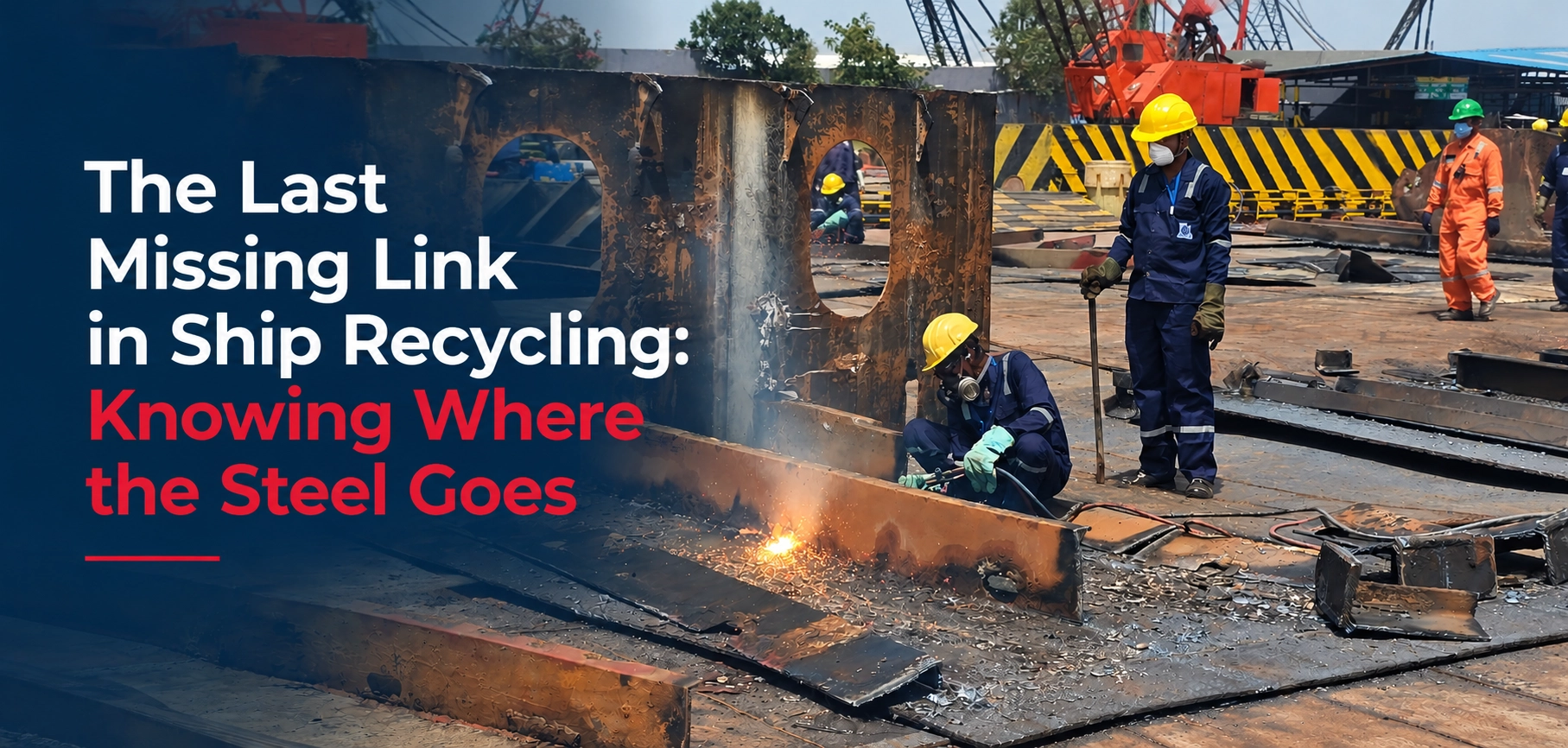
Ship recycling has developed sophisticated systems for tracing hazardous materials, but far less attention is given to tracing the steel recovered from a vessel. Dr. Anand Hiremath proposes exploring ...


Download GMS App