28 Sep 2026
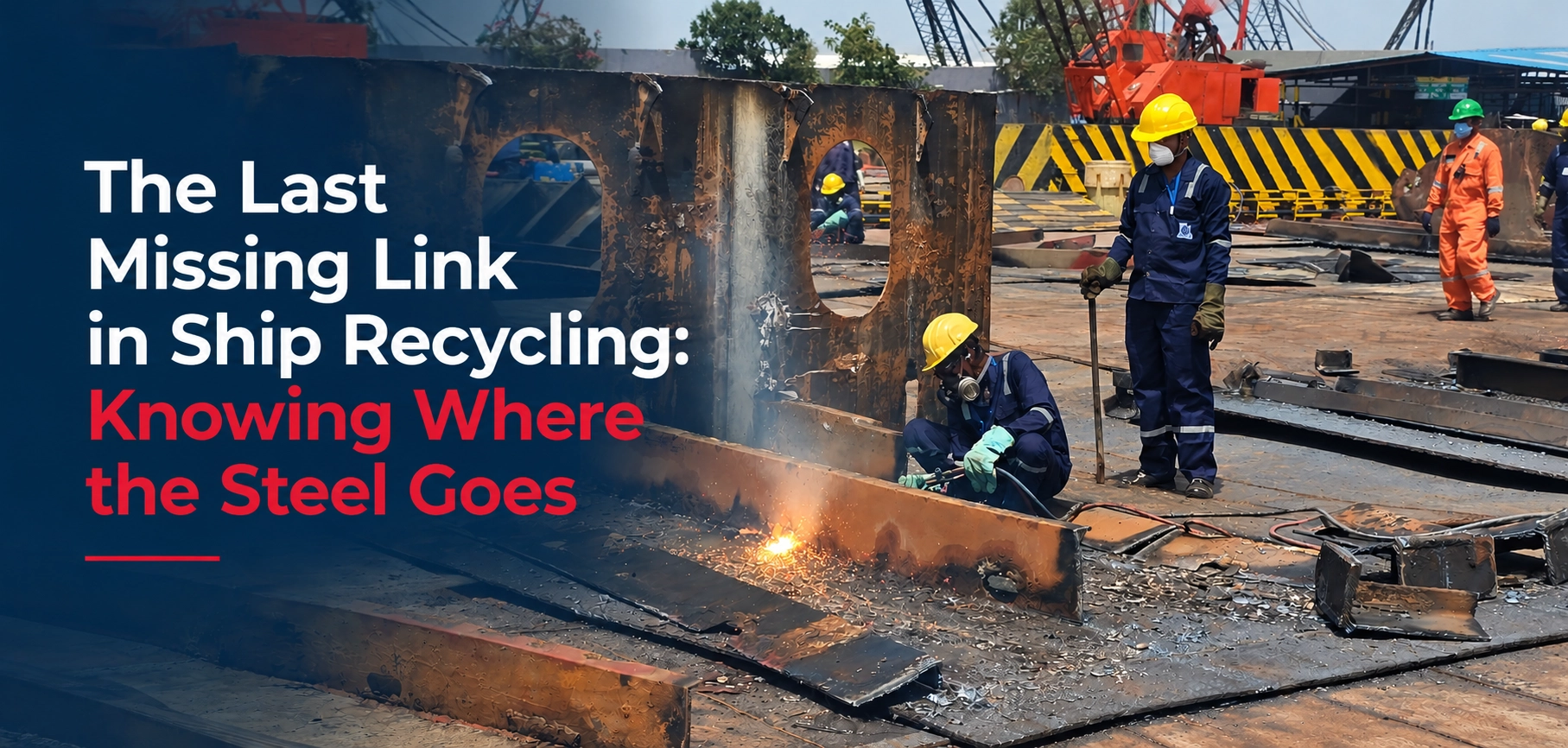
Ship recycling has developed sophisticated systems for tracing hazardous materials, but far less attention is given to tracing the steel recovered from a vessel. Dr. Anand Hiremath proposes exploring a Ship-Recycled Steel Passport that could connect recovered steel to its vessel of origin, recycling facility, processing route and downstream application.
An end-of-life ship can arrive at a recycling yard carrying an extraordinary amount of documentation.
We know its IMO number. We know its flag. We know its class history. We know the hazardous materials identified on board. We know the facility authorised to recycle it. There is a Ship Recycling Plan. There are surveys, certificates and procedures governing how the vessel should be dismantled and how hazardous materials should be managed.
Then the cutting starts.
Thousands of tonnes of steel are recovered and, somewhere along that chain, one of the most comprehensively documented industrial assets in the world can become something remarkably anonymous: scrap.
I believe this is one of the next gaps responsible ship recycling needs to address.
On 16 September 2026, India's Ministry of Steel and Ministry of Ports, Shipping and Waterways held a joint meeting to examine the use of steel obtained from recycled ships. The Department of Science and Technology, Bureau of Indian Standards, Gujarat Maritime Board and Ship Recycling Industries Association were among the stakeholders involved.
The discussion focused on expanding the applications for secondary steel recovered through ship recycling and increasing the value generated from the recycling process.
This is an important development.
But the opportunity is bigger than finding more uses for recovered steel.
We should also ask whether the maritime industry can preserve more information about that steel after the vessel has been dismantled.
Ship recycling has made considerable progress in material traceability.
The Inventory of Hazardous Materials identifies substances that require particular attention. The Ship Recycling Plan determines how they should be handled during dismantling. Recycling facilities have procedures for segregation, storage and disposal. Downstream waste management is increasingly scrutinised.
This is how it should be.
Yet there is an interesting imbalance in the system.
We have become increasingly good at tracing what we do not want from a ship.
We are much less sophisticated at tracing what we do want.
Steel represents the overwhelming majority of the recoverable material in most commercial ships. In South Asian recycling markets, it is also central to the commercial value of the vessel.
Yet once recovered steel moves into the downstream market, information linking that material to the vessel, recycling facility, processing method and eventual application can become limited.
That should make us pause.
Responsible recycling should not finish when hazardous materials have been safely removed and the final block has been cut.
There is another story after that.
In May this year, I wrote that ship recycling needs a steel life cycle debate rather than another geography debate.
The argument was straightforward.
If we want to compare the environmental performance of different recycling models, we need to understand what actually happens to the materials recovered from a ship.
How much steel is reused?
How much is re-rolled?
How much is remelted?
How far does it travel?
What processing does it require?
Where does it ultimately return to productive use?
I proposed that a Ship Recycling Steel Life Cycle Report could make some of these material flows visible.
There was also a practical reason for raising the issue.
During a GMS team visit to Alang in June 2025, one of the gaps identified was the absence of sufficiently developed certification guidelines specifically for ship-recycled steel.
The discussion held by the Government of India this month brings these two issues together.
If India is going to expand the applications available to steel recovered from ships, then identification, testing, classification and traceability should be part of that discussion from the beginning.
This is where the debate needs some caution.
A ship is not a warehouse containing thousands of identical steel plates waiting to be given a new certificate.
Vessels have different construction histories.
They operate in different environments. They carry different cargoes. They experience corrosion, repairs, fatigue and coating systems over decades of operation. Steel recovered from different areas of the same vessel may also have different characteristics and different appropriate uses.
Certification should therefore not become a shortcut for declaring all recovered ship steel suitable for all applications.
It should do the opposite.
A credible system should make it easier to distinguish between materials.
Some recovered steel may be suitable for direct reuse.
Some may be suitable for re-rolling.
Some should enter a melting route.
Some may require further assessment before any secondary application is considered.
The question is not whether ship steel can be reused.
It already is.
The question is whether we can become better at demonstrating what the material is, where it came from and where it can appropriately go next.
There may be a relatively simple starting point.
The vessel already has one of the strongest identity systems in global industry: the IMO number.
That identity follows the ship throughout its operating life.
Why should the connection end completely when recycling begins?
I am not suggesting that every individual plate needs to carry an IMO number for the rest of its life. That would be neither practical nor necessary.
But identified batches of recovered material could retain a basic connection to the vessel from which they originated.
A simple Ship-Recycled Steel Passport could, for selected material streams, record information such as:
the vessel IMO number;
the ship recycling facility;
the date of recovery;
the category of steel;
relevant testing results;
the processing route, such as direct reuse, re-rolling or melting; and
the downstream processor or application where appropriate.
This does not need to begin as another international regulatory requirement.
It could start as a pilot.
The purpose would be to find out how much useful information can realistically follow recovered steel without creating a documentation system so cumbersome that nobody uses it.
There is another part of this discussion that should not be overlooked.
Steel is not only an environmental output from ship recycling.
It is also one of the foundations of ship recycling economics.
Every week, the recycling market demonstrates this relationship.
The same vessel can attract materially different recycling offers in India, Bangladesh, Pakistan and Turkey.
That difference is not random.
Domestic steel demand matters. Currency matters. Banking and liquidity matter. Yard appetite matters. The market for machinery and non-ferrous materials matters. Regulation and compliance requirements matter. So does the ability of a local downstream market to absorb the materials recovered from the vessel.
This is why a recycling price is not simply a global steel price multiplied by a ship's light displacement tonnage.
Each recycling destination converts the recoverable value of a ship through its own local industrial and commercial system.
GMS sees this directly because a cash buyer sits between the shipowner making an end-of-life decision and the recycling market that must ultimately recover value from the vessel.
This is an important part of the steel certification discussion.
If properly tested ship steel can enter a wider range of appropriate applications, the benefit does not necessarily stop with the downstream steel buyer.
Greater confidence in the material can improve marketability.
A broader downstream market can improve the options available to recyclers.
Those economics can, in turn, influence the value that recycling markets are able to place on ships.
It would be wrong to claim that certification will automatically increase recycling prices. Vessel type, freight markets, currencies, financing, location, compliance requirements and local demand will continue to affect every transaction.
But it would be equally wrong to treat downstream steel policy as something unrelated to shipping.
What happens to the steel after recycling can influence the economics before recycling.
India has a practical advantage if it chooses to move in this direction.
Alang provides a concentrated ship recycling ecosystem with compliant recycling facilities, experienced recyclers, re-rolling mills, scrap processors, traders, equipment resellers, regulators and decades of accumulated knowledge.
It is difficult to design a useful standard without understanding how material actually moves through that system.
So rather than beginning with a perfect national framework on paper, India could begin with a controlled pilot.
Select several ships of different types.
Identify batches of steel during dismantling.
Follow those batches from vessel to yard, from yard to processor and, where practical, into the next application.
Test the material.
Record what information can realistically be retained.
Compare direct reuse, re-rolling and melting routes.
Measure the cost of traceability.
Identify where the process becomes unnecessarily burdensome.
Then develop the standard around what actually works.
Ship recycling has suffered in the past when policy has been developed too far away from operating reality.
This is an opportunity to avoid repeating that mistake.
Today, a responsible shipowner can demonstrate that an end-of-life vessel was sent to an authorised recycling facility and recycled in accordance with applicable requirements.
That is important.
But imagine what could come next.
An owner could potentially know that a vessel produced a defined quantity of recoverable steel, that a certain share was re-rolled, another share entered steelmaking, identified components were reused, and hazardous materials followed documented disposal routes.
That would give the owner something far more useful than a photograph of the vessel being dismantled and a completion certificate.
It would provide an account of what the vessel became.
For shipping companies facing increasing scrutiny over lifecycle emissions, resource use and circularity, that information could become valuable.
It could also improve the quality of sustainability reporting.
There is a great deal of discussion in shipping about circular economy principles. Ship recycling is one of the few points in the maritime asset cycle where circularity can be physically measured.
We should take advantage of that.
The Hong Kong Convention has given the industry an international framework for safe and environmentally sound ship recycling.
That achievement should be recognised.
But conventions should not stop industries from continuing to improve.
The first question was whether ships could be dismantled safely.
Then came stronger attention to hazardous materials, worker protection, environmental controls, facility authorisation and downstream waste management.
The next question should be what happens to the useful materials we recover.
India is particularly well placed to answer it.
The country has scale.
It has recycling infrastructure.
It has a large domestic steel market.
It has re-rolling capacity.
It has regulators now actively considering broader applications for recovered ship steel.
And it has decades of practical knowledge about extracting value from ships that have reached the end of their operating lives.
The meeting on 16 September is therefore important, but not simply because it may result in more applications for recycled steel.
It creates an opportunity to think about the identity of that steel.
When a ship reaches the end of its life, its IMO number eventually disappears from the active fleet register.
Its steel does not disappear.
It moves somewhere else.
After spending so much effort documenting the ship's journey to the recycling yard, perhaps it is time we became equally interested in documenting the journey that begins there.
That may be the last missing link in making ship recycling a truly measurable circular economy.
Contact Us
Ship Recycling Team
Dr. Anand Hiremath is a leading voice in sustainable ship recycling, with a strong foundation in civil and environmental engineering and more than a decade of specialised expertise in safe and environmentally sound ship recycling.
He holds a master’s degree in Environmental Engineering from IIT Guwahati and earned his PhD from IIT Bombay, where his pioneering research on the Integrated Risk Assessment Framework for Best Practices in Ship Recycling contributed to advancing safety, environmental responsibility, and structured risk management within the industry.
As Chief Executive Officer of the Sustainable Ship and Offshore Recycling Program (SSORP), Dr. Hiremath plays a key role in strengthening responsible ship recycling practices across the sector. He works closely with recycling yards to support compliance with the Hong Kong Convention (HKC) for the safe and environmentally sound recycling of ships. Under his leadership, SSORP has overseen more than 100 Inventory of Hazardous Materials (IHM) surveys and successfully supported the recycling of over 130 end-of-life vessels.
His commitment to worker safety and practical capacity-building is reflected in more than 800 free safety awareness sessions conducted at recycling yards across the Indian subcontinent, benefiting over 13,000 workers. These initiatives have helped improve awareness, hazard recognition, and safe work practices at the yard level.
Beyond his operational leadership, Dr. Hiremath contributes to the development of the next generation of ship recycling professionals as Course Director for the Lloyd’s Maritime Academy Ship Recycling course in London. His global influence extends through his involvement in major international research and improvement initiatives, including the EU-funded DIVEST project and the Green Alang Initiative, both focused on improving environmental standards and sustainability in ship recycling.
Dr. Hiremath’s work has been published in leading international scientific journals, reinforcing his position as a thought leader in the field. He is also the author of The Green Handbook: A Practical Checklist to Monitor the Safe and Environmentally Sound Recycling of Ships, a practical industry resource for monitoring responsible ship recycling practices.
His professional credentials include Lead Auditor certifications for ISO 45001 and ISO 9001, certification as a Hazmat expert, Social Auditor, Responsible Steel Auditor, and sustainability practitioner.
With his combination of technical expertise, field experience, academic contribution, and commitment to worker safety and environmental protection, Dr. Anand Hiremath remains at the forefront of the global movement toward safer, greener, and more sustainable ship recycling.
Contact Us
Ship Recycling Team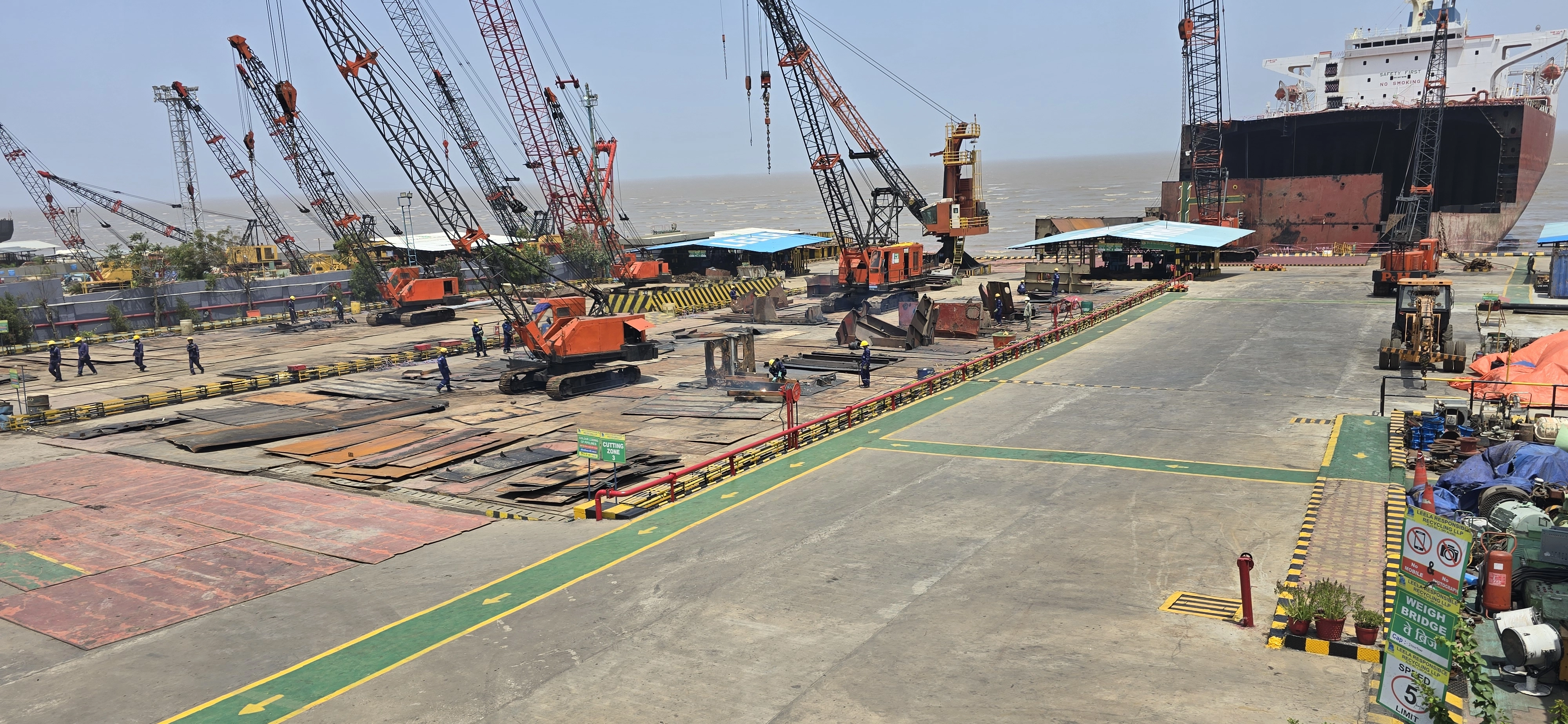
The Hong Kong Convention has now been in force for more than a year.
Before 26 June 2025, much of the industry's attention was on when the Convention would enter into force, whether recycling ...
There is a certain comfort in consistency, and the NGO Shipbreaking Platform offers it in abundance. Whatever the question, ...


Download GMS App