25 Mar 2021
Seafarers are required to undergo training relevant to their duties before working onboard a vessel. The training requirements are governed through standards such as STCW and are updated as operating practices and safety requirements develop.
But what training is provided to the workers who carry out ship recycling?
When this article was first published in 2021, we looked at the compulsory safety training provided to workers at Alang by the Gujarat Maritime Board, or GMB.
A lot has changed since then.
The Hong Kong Convention entered into force on 26 June 2025. Training systems at Alang have continued to develop, and recent discussions with workers and safety professionals have also given us a clearer picture of what makes safety training effective in practice.
The basic principle, however, has not changed.
Before workers carry out potentially hazardous ship recycling activities, they need to understand the work, the hazards involved and the controls expected of them.
Gujarat Maritime Board has operated a Safety Training and Labour Welfare Institute at Alang since 2003.
Workers are required to receive safety training before becoming eligible to work in the recycling yards.
The structure of that training has changed since our original article was published.
In 2021, GMB's training system was described as including a 12-day comprehensive safety course, a three-day refresher programme and a separate two-day course for gas cutters.
GMB's current public information now states that workers require six days of "Basic Safety for All" training to work in Alang. Workers involved in cutting operations also undergo two days of specialized Gas Cutter Safety Training.
The courses continue to be provided free of charge by GMB, with certificates issued at the end of the training.
This change is worth noting because training programmes should not be treated as static. As the industry develops, the content and structure need to develop with it.

Gujarat Maritime Board training center
The purpose of basic training is to prepare workers for the types of hazards they may encounter during recycling operations.
The original GMS article highlighted areas including:
hazards associated with gas cutting
correct use of Personal Protective Equipment
working in confined spaces
working at height
hazardous atmospheres
metal and material handling
fire and explosion hazards
firefighting
first aid
emergency response
environmental hazards
housekeeping
These remain practical issues in ship recycling.
Gas cutting deserves particular attention because it is one of the most common activities during dismantling.
Workers carrying out cutting operations need to understand the equipment they are using, the PPE required, the risks of fire and explosion, and the precautions necessary before and during the work.
The specialized gas cutter training provided at Alang reflects that difference between general yard safety and job-specific training.
Completing an initial course is important, but safe working depends on what happens afterwards.
This was already recognised in the original article, which discussed refresher training and the use of accident case studies to help workers understand how incidents occurred and how similar situations could be prevented.
Recent GMS safety discussions have reinforced the same point.
Safety can weaken when a task becomes familiar and workers or supervisors begin to treat routine checks as unnecessary.
That is why everyday practices matter.
Permit-to-work controls, hot-work checks, confined-space precautions, safe lifting, near-miss reporting, toolbox talks and emergency drills all help turn formal training into something that remains visible during daily work.
In a recent GMS discussion on ship recycling safety, Dr. Anand Hiremath highlighted how repeated safety awareness is used to reinforce these habits across recycling yards.
The objective is not simply to tell workers that a rule exists.
It is to make the safety check part of the job.
There is another practical issue that deserves more attention than it received when this article was first written.
Alang's workforce includes workers from different parts of India, with different languages and educational backgrounds.
Safety communication therefore has to be understandable to the person carrying out the task.
In GMS's 2026 discussion with the Alang Sosiya Ship Recycling & General Workers' Association, this came through clearly.
Local-language instructions, demonstrations, pictures and practical examples can help workers understand hazards more effectively than relying only on written procedures.
This is especially relevant when training covers activities such as hot work, PPE use, hazardous materials, emergency response or entering areas where conditions may change.
A procedure can exist on paper and still fail if the worker does not understand what it requires.
Training therefore needs to be technically correct, but also practical.
India ratified the Hong Kong Convention in 2019.
Since the original article was published, the Convention has entered into force internationally.
From 26 June 2025, authorized ship recycling facilities operating under HKC are required to have a Ship Recycling Facility Plan that addresses, among other things, worker safety and training.
IMO guidance goes further.
Training programmes should cover workers across the facility, including contractor personnel. The facility should identify the type and frequency of training required, review the programme periodically and make sure workers have received appropriate training before carrying out recycling operations.
This makes training more than an isolated welfare activity.
It forms part of the operating system of the recycling facility.
The Convention provides the structure, but effective implementation still depends on what happens inside the yard each day.
A worker can receive good training and still face unsafe conditions if the work itself is poorly planned or controlled.
This is why supervisors and safety personnel also have an important role.
They need to make sure work permits are meaningful, equipment is suitable, conditions are checked and workers can stop when something changes.
Near misses also need to be treated as opportunities to learn.
If a worker reports a problem with equipment, a lifting arrangement, a hot-work condition or another hazard, the value comes from pausing the work, correcting the problem and sharing what was learnt.
This is where training becomes part of the wider safety culture rather than something completed once in a classroom.
The next article in the Demystifying Ship Recycling series looks more closely at training for supervisors and HSE personnel.
When we first published Issue 16, India had already ratified HKC but the Convention had not yet entered into force.
Today, the situation is different.
HKC is in force.
The GMB training structure has evolved.
Worker safety is more formally connected with facility authorization and the Ship Recycling Facility Plan.
Recent discussions in Alang have also placed more emphasis on practical communication, local-language training and worker participation.
But the central point of the original article remains the same.
Ship recycling involves work that can carry serious risks if it is not properly understood and controlled.
Training gives workers the knowledge to recognise those risks before work begins.
Repeated awareness, practical supervision and clear communication help keep that knowledge relevant once the work is underway.
Training should therefore not be viewed simply as a requirement to be completed.
It is one of the foundations of safe ship recycling.
Contact Us
Ship Recycling Team
Kiran Thorat is a Trader at GMS, where he looks after sustainable ship recycling projects. Kiran believes that Sustainable Recycling is an integral part of Sustainable Shipping and a notable example of a circular economy. He holds a Bachelor's Degree from the Marine Engineering and Research Institute (DMET), India, and a Master's Degree in Energy, Trade, and Finance from Cass Business School, London.
Dr. Anand M. Hiremath is a Civil Engineer and holds a Master's Degree in Environmental Engineering from the Indian Institute of Technology Guwahati (IIT Guwahati), India. He was awarded Doctorate Degree in the year 2016 for his research work on Ship Recycling by the Indian Institute of Technology Bombay (IIT Bombay), India. In addition, he has a diploma in Industrial safety, is a qualified lead auditor for ISO 9k, 14k and 18k. Dr. Hiremath published the first practical handbook on ship recycling, entitled: "The Green Handbook: A Practical Checklist to Monitor the Safe and Environmentally Sound Recycling of Ships" which highlights the procedures the GMS RSRP follows to help both Ship and Yard Owners recycle a vessel in an environmentally-friendly manner. He is the Chief Sustainability Officer of GMS.
Contact Us
Ship Recycling Team
The Hong Kong Convention has now been in force for more than a year.
Before 26 June 2025, much of the industry's attention was on when the Convention would enter into force, whether recycling ...
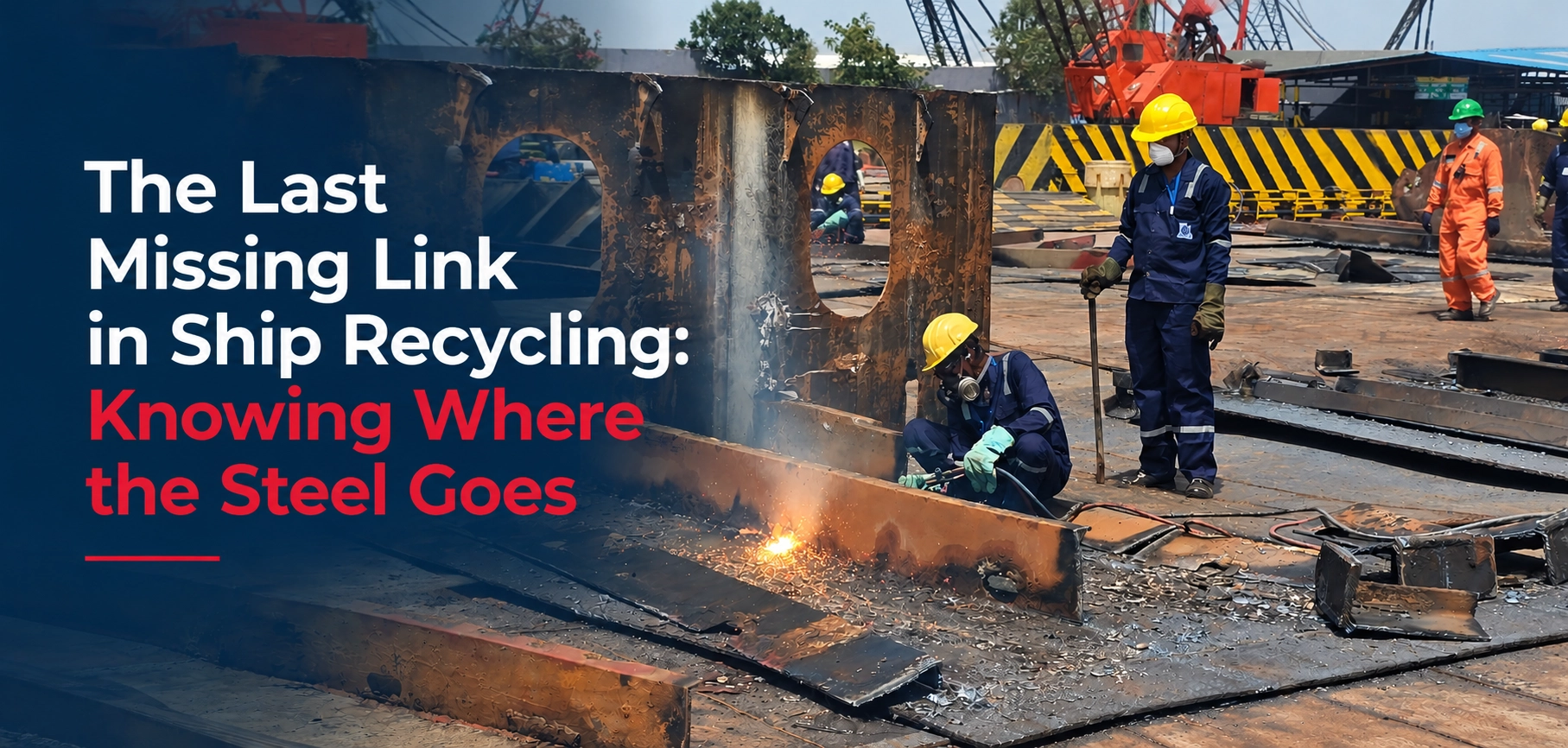
Ship recycling has developed sophisticated systems for tracing hazardous materials, but far less attention is given to tracing the steel recovered from a vessel. Dr. Anand Hiremath proposes exploring ...


Download GMS App