25 Jun 2025
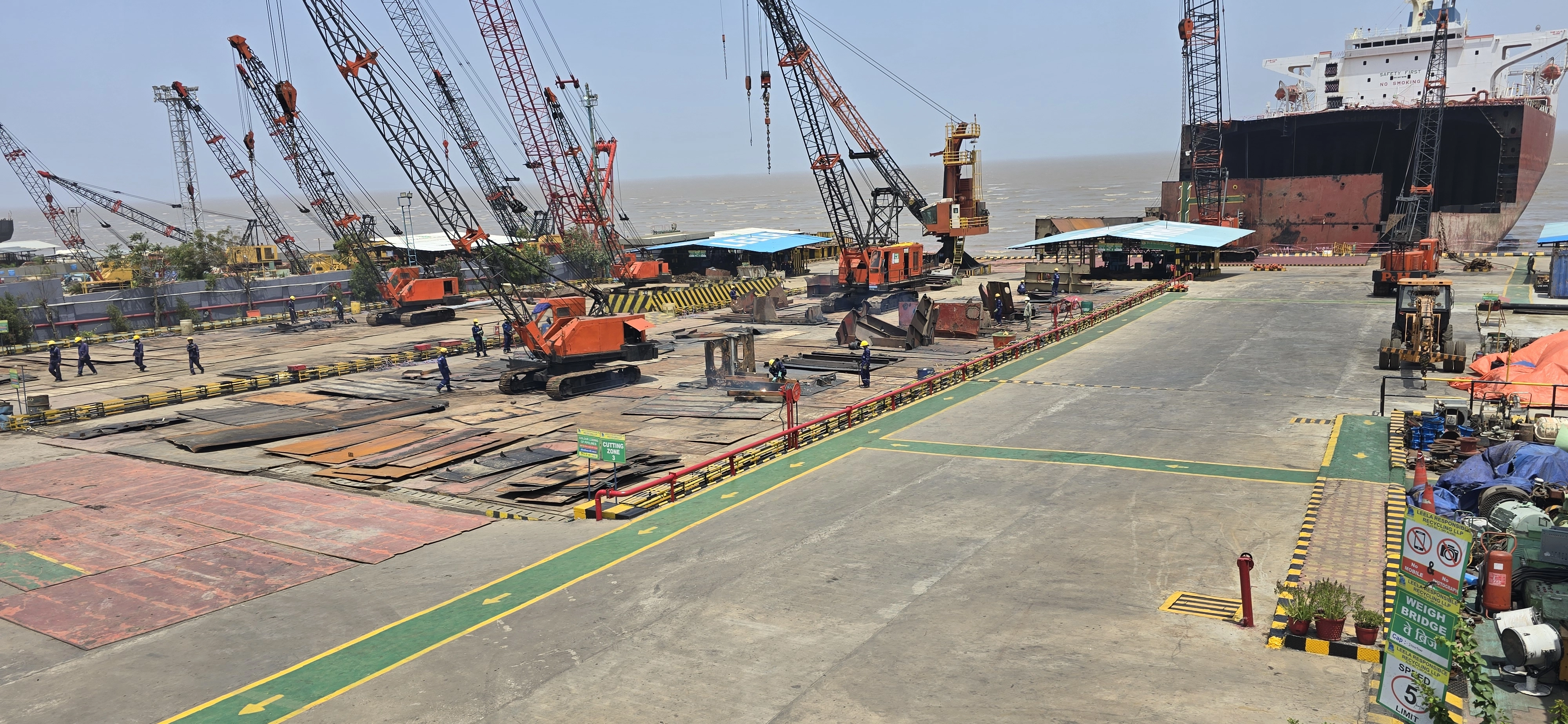
Alang-Sosiya in Gujarat is the centre of India's ship recycling industry and one of the world's largest ship recycling clusters.
GMS maintains regular engagement with the Alang recycling ecosystem through its commercial, technical and sustainability work. Our teams continue to interact with recycling facilities, workers and other industry stakeholders, giving us an ongoing view of how the sector is developing. Nayeem Noor and Kiran Thorat have also been on the ground in Alang recently as part of this continuing engagement.
The industry has now moved beyond preparation for the Hong Kong International Convention for the Safe and Environmentally Sound Recycling of Ships. The Convention entered into force on 26 June 2025, and the focus today is on implementation.
For shipowners considering India for an end-of-life vessel, the question is therefore not simply whether a ship can be recycled in Alang.
The more useful question is whether the particular recycling facility selected for that vessel can meet the owner's technical, regulatory, ESG and commercial requirements, and demonstrate how those requirements are being implemented in practice.
Current figures for the Alang-Sosiya cluster include:
Around 98 percent of India's ship recycling takes place at Alang-Sosiya.
The recycling cluster extends along approximately 10 kilometres of coastline.
There are 153 recycling plots.
131 plots are allotted.
115 facilities have attained Hong Kong Convention compliant status.
Reported recycling capacity is approximately 4.5 million metric tonnes per annum.
The Hong Kong Convention has been in force since 26 June 2025.
India's Recycling of Ships Regulations, 2026 now form part of the country's regulatory framework.
These figures show the scale of the infrastructure available in Alang. They do not, however, remove the need to assess each recycling facility individually.
Alang has several geographic and industrial characteristics that have supported ship recycling for more than four decades.
Its coastline has a significant tidal range and a gradually sloping shore, allowing large vessels to be positioned for recycling.
Around this location, a much wider industrial ecosystem has developed.
It includes recycling facilities, steel processors, re-rolling mills, equipment traders, transport companies, gas suppliers, laboratories, training facilities and hazardous-waste management infrastructure.
This wider network is important because an end-of-life ship is not simply converted into scrap steel.
Machinery, generators, pumps, valves, motors, cables, navigation equipment, furniture and other components may also be recovered, refurbished or returned to productive use.
For shipowners, this ability to recover both materials and equipment is an important part of Alang's circular-economy value.
For many years, industry discussions focused on when the Hong Kong Convention would enter into force.
That stage has passed.
The Convention became legally effective on 26 June 2025 and establishes requirements covering the ship, the recycling facility and the process used to prepare and recycle the vessel.
For shipowners, this means recycling compliance starts before the ship reaches the yard.
Several elements of the process are connected:
the Inventory of Hazardous Materials, or IHM
selection of an appropriately authorised recycling facility
preparation of a vessel-specific Ship Recycling Plan
the final survey
and the International Ready for Recycling Certificate, where applicable.
These should not be treated as separate paperwork exercises.
The information in the IHM should help the yard understand the vessel. The Ship Recycling Plan should use that information to prepare the dismantling process. The final survey then verifies that the relevant requirements are in place before recycling begins.
Good preparation makes the entire process easier for both the owner and the recycling facility.
Certification provides the framework, but implementation at the facility level is equally important.
Owners should understand how the selected facility applies its systems in practice, particularly in areas such as:
safe-for-entry procedures
safe-for-hot-work procedures
gas testing
lifting operations
work at height
emergency preparedness
worker training
personal protective equipment
hazardous-material handling
waste segregation
impermeable working areas where required
drainage and contamination controls
and recycling documentation.
The Ship Recycling Plan should also correspond with the actual vessel being dismantled.
The hazardous materials identified in the IHM should be reflected in the controls being used at the facility, and waste movements should be properly recorded.
This is why recycling facilities in the same geographical location should not automatically be considered identical.
Facility-level performance matters.
Recycling a vessel is a sequence of controlled activities rather than a single dismantling operation.
Before substantial cutting begins, the recycling facility needs to understand the vessel's structure, tank arrangement, machinery, hazardous materials, remaining oils and wastes, and the proposed dismantling sequence.
Different types of vessels also create different technical challenges.
A bulk carrier is not the same recycling project as a tanker. An LNG carrier can require a different approach again. Offshore units such as FPSOs and FSOs may introduce additional structural, towing and hazardous-material considerations.
Depending on the vessel, recycling activities can include:
management or removal of remaining fuel and operational wastes
gas-freeing and preparation for hot work
hazardous-material removal
machinery and equipment dismantling
recovery of reusable components
progressive structural cutting
separation of steel and non-ferrous materials
storage and transfer of hazardous wastes
and preparation of completion records.
The exact process should reflect the vessel.
This is one of the reasons the Ship Recycling Plan needs to be genuinely vessel-specific.
The Inventory of Hazardous Materials should identify hazardous materials on board, their location and their approximate quantities.
A properly maintained IHM gives the recycling facility better information before dismantling begins.
An outdated or incomplete IHM does the opposite.
Part I should have been maintained throughout the vessel's operational life. When the decision to recycle is taken, Parts II and III are prepared as applicable to cover operationally generated wastes and stores remaining on board.
Another important area is material recorded as PCHM, or Potentially Containing Hazardous Material.
During normal operations, some parts of a vessel may not be safely accessible for sampling. Recording those locations as PCHM can therefore be appropriate.
The situation changes when the vessel approaches recycling.
Some of those areas may now be accessible, giving the owner an opportunity to reduce uncertainty before dismantling starts.
An IHM should therefore not simply be handed to the recycling facility as an old compliance document. It should be reviewed as part of the preparation for recycling.
End-of-life vessels can contain asbestos, oils, contaminated residues, heavy metals, ozone-depleting substances, PCBs and other materials that require controlled handling.
Identifying these materials is only the beginning.
There also needs to be a clear process for:
removal
segregation
temporary storage
transportation
treatment
and final disposal.
Alang has developed waste-management infrastructure to support the recycling industry, including facilities for hazardous waste treatment and disposal.
For the shipowner, the important point is maintaining a traceable chain.
For sensitive waste streams, it should be possible to establish what was removed from the vessel, how much was removed, where it was stored, who transported it and where it ultimately went.
This becomes particularly important where an owner intends to report the recycling project as part of its ESG or sustainability programme.
Responsible recycling claims are much stronger when they can be supported by evidence.
Ship recycling combines a number of high-risk industrial activities.
Workers may be involved in confined-space entry, hot work, heavy lifting, work at height and the handling of hazardous materials, often while the physical structure of the ship is changing around them.
Alang's formal safety infrastructure has developed significantly.
More than 157,000 workers have undergone training through the Gujarat Maritime Board's Safety Training and Labour Welfare Institute since the institute was established.
Medical and emergency-response infrastructure serving the Alang area has also continued to develop.
These are important improvements.
At the same time, our regular engagement with recycling facilities and workers in Alang continues to highlight one simple point: safety information has to reach the person actually doing the job.
Alang's workforce includes people from different regions of India and different language backgrounds.
Practical demonstrations, photographs, toolbox talks, local-language instruction and task-specific discussions can therefore be just as important as formal written procedures.
A worker entering a tank or preparing for hot work needs to understand the hazard, the control measures and what to do if conditions change.
That is where a safety system proves its value.
For shipowners, the objective is not to manage the recycling facility themselves.
It is to make sure the vessel is delivered with the right documentation, to the right facility, through a process that meets the owner's compliance, ESG and commercial requirements.
Good preparation before delivery can make the recycling process considerably smoother.
This can include:
making sure the IHM is current
providing relevant technical records
assessing the selected recycling facility
reviewing the Ship Recycling Plan
understanding the vessel's delivery condition
confirming applicable flag and regulatory requirements
agreeing monitoring requirements
and defining the final documentation expected from the recycling project.
Owners can also decide the level of independent supervision required during recycling.
This can be particularly useful for complex vessels or where the owner requires detailed compliance or ESG reporting.
Even experienced shipowners may only recycle vessels occasionally, while the regulatory and documentation requirements around end-of-life ships continue to develop.
Where additional support is required, specialist programmes can help connect the owner's requirements with the work taking place at the recycling facility.
Through the Sustainable Ship and Offshore Recycling Program, SSORP, GMS can support owners across different stages of the process.
This can include IHM preparation and review, IHM gap analysis, recycling-facility assessment, Ship Recycling Plan review, on-site supervision, worker-safety awareness and final reporting.
The purpose is not to introduce another layer of paperwork.
The value comes from linking the vessel's technical information, the owner's expectations and what is actually happening at the recycling facility.
This can be particularly useful for tankers, LNG carriers, offshore units and other technically complex recycling projects.
Discussions about ship recycling often concentrate on where the vessel is dismantled.
That is only part of the environmental picture.
An end-of-life vessel contains thousands of tonnes of material that can return to productive use.
Steel represents the largest proportion, but ships also contain non-ferrous metals, machinery, generators, pumps, cables, valves, furniture and many other reusable items.
India already has a substantial market for recovering and reusing many of these materials.
Some recovered steel may enter remelting routes. Other material may be suitable for re-rolling or different downstream applications.
These pathways can have different energy and environmental implications.
For that reason, the next stage of the ship recycling discussion should go beyond what happens inside the recycling facility.
We also need to understand what happens to the recovered material afterwards.
A ship arriving at a recycling facility is a highly documented industrial asset.
Its IMO number is known. Its ownership and technical history can be established. It has an IHM. The recycling facility is identified. A Ship Recycling Plan is prepared and documentation accompanies the dismantling process.
Thousands of tonnes of steel may then be recovered.
Further down the supply chain, however, the connection between that steel and the original vessel can gradually disappear.
This is an area where we believe the industry has an opportunity to improve.
A practical ship-recycled steel traceability system could potentially record information such as:
vessel of origin
IMO number
recycling facility
recycling date
steel category
relevant test results
processing route
and downstream application.
At GMS, we have proposed exploring this through the concept of a Ship-Recycled Steel Passport.
This does not necessarily need to begin as another complex international certification system.
It could start through controlled pilot projects involving recyclers and downstream steel users.
Alang may be particularly suitable for this because recycling facilities, steel processors, re-rolling mills, equipment traders and a large domestic steel market already operate within the same wider ecosystem.
If the industry can eventually demonstrate not only that a ship was recycled responsibly, but also where significant quantities of its recovered material went, the circular-economy value of ship recycling becomes easier to measure.
The Hong Kong Convention and the EU Ship Recycling Regulation are separate regulatory regimes.
HKC compliance does not automatically mean that a recycling facility can recycle an EU-flagged vessel that falls under the EU Ship Recycling Regulation.
EU-flagged vessels subject to the Regulation must be recycled at a facility appearing on the current European List of ship recycling facilities.
Indian facilities have been taking part in the European assessment process, and the position continues to develop.
Owners should therefore check the current European List when making a recycling decision rather than relying only on an HKC-related certificate or an earlier assessment.
This is a good example of why facility selection should consider the vessel's flag, trading history and applicable legal framework, not only the technical capability of the recycling yard.
Responsible ship recycling also needs to work commercially.
A recycling facility purchases the vessel and recovers value through steel, machinery, non-ferrous metals and other materials.
The price a recycler can offer is therefore affected by several factors, including:
domestic steel prices
foreign exchange rates
vessel type
light displacement tonnage
machinery and non-ferrous content
financing conditions
freight markets
sanctions and compliance risks
recycling-facility availability
and competition between recycling destinations.
Strong freight markets can encourage owners to keep older vessels trading.
Currency movements can affect recycler purchasing power.
Different vessel types can also attract very different levels of interest from recycling markets.
For these reasons, an owner should not assess a recycling transaction solely on the highest headline price per LDT.
Transaction certainty also has value.
Payment security, sanctions exposure, delivery requirements, facility capability, documentation, monitoring and compliance conditions should all form part of the commercial assessment.
Responsible recycling and a commercially sound transaction do not have to be competing objectives.
For an owner evaluating facilities in Alang, we would start with eight practical questions.
Review the facility's current authorisation and applicable HKC status.
Do not rely only on an old certificate or presentation.
Check whether repairs, conversions, replacement equipment and other changes during the ship's operational life have been properly incorporated.
Where recycling has already been decided, Parts II and III should also be prepared as applicable.
Some uncertainty may have been unavoidable while the vessel was trading.
Before recycling begins, determine whether any of those locations can now be investigated safely.
The plan should reflect the actual vessel, her hazardous materials, structural arrangement, tanks and proposed dismantling sequence.
Understand where hazardous materials will be removed, stored, transported and ultimately treated or disposed of.
Agree what records will be provided.
Review the facility's approach to gas testing, safe-for-entry, hot work, lifting, work at height, emergency response and permit-to-work procedures.
Do not look only at training attendance.
Consider whether workers understand task-specific hazards and whether instructions are communicated effectively.
Agree the reporting requirements before dismantling begins.
It is much more difficult to reconstruct records after the vessel has been completely recycled.
Alang has changed substantially over the past two decades.
That does not mean every concern about ship recycling should be dismissed. It also does not mean every recycling facility in Alang should automatically be treated as equal.
It means assessments should be based on current evidence and actual performance.
The Hong Kong Convention is now in force. India has established a national legal and regulatory framework for ship recycling. More than one hundred Alang facilities have attained HKC-compliant status. Worker training, environmental controls, waste-management systems, medical infrastructure and operational procedures have developed significantly.
At the same time, there is room for further progress.
Consistent implementation across facilities remains important. Worker engagement needs to continue. Downstream material and waste traceability can improve. The position of Indian facilities under the EU Ship Recycling Regulation continues to develop. Ship-recycled steel also needs better identification and traceability if its full circular value is to be demonstrated.
For shipowners, the decision should therefore not be reduced to a broad geographical label.
The more useful questions are practical:
Which facility will recycle the vessel? What standards does it meet? How will workers be protected? How will hazardous materials be managed? What will happen to the recovered materials? What commercial and compliance risks need to be considered? And can each of those answers be demonstrated with evidence?
Those are the questions that ultimately determine whether a ship is recycled responsibly and whether the process meets the owner's requirements.
Last reviewed and updated: 29 September 2026
Contact Us
Ship Recycling Team
Kiran Thorat is a trader at GMS and Head of India Office. He looks after sustainable ship recycling projects (an integral part of sustainable shipping and circular economy). He holds a Bachelor's Degree from the Marine Engineering and Research Institute (MERI), India and a Master's Degree in Energy, Trade, and Finance from Cass Business School, London.
Nayeem Noor is currently serving as the VP - Business Development at GMS, the world’s largest buyer of ships and offshore assets for recycling. An alumnus of the prestigious Indian Institute of Technology (IIT) Roorkee, Nayeem combines market intelligence with disciplined communication, helping counterparties align on timing, risk, and execution across shipping and offshore asset cycles.
Contact Us
Ship Recycling Team
Strong freight, scarce recycling candidates and resilient subcontinent pricing defined Q3 2026. GMS team examines why ships stayed trading, how the major recycling markets responded, and why today's ...
The Hong Kong Convention has now been in force for more than a year.
Before 26 June 2025, much of the industry's attention was on when the Convention would enter into force, whether recycling ...


Download GMS App