05 Jun 2026
There is a certain comfort in consistency, and the NGO Shipbreaking Platform offers it in abundance. Whatever the question, the answer is a ban. Whatever the progress, the verdict is insufficient. Whatever the country, the conclusion is the same: not good enough, please remove from the list.
Their latest joint press release, produced alongside EUROFER and Recycling Europe, the European steel and scrap lobbies, calls on the EU to ban both beaching and landing methods outright and to strike Turkish yards from the European List “until necessary improvements are properly implemented.”
One has to admire the ambition.
Having spent two decades insisting that beaching in South Asia was the great evil of ship recycling, the Platform has now discovered that the landing method in Turkey is also unacceptable. Turkey, let us remember, was for years presented by the same chorus as the more acceptable alternative. Not perfect, of course, because nothing ever is, but at least closer, cleaner, and more European in spirit.
Now, apparently, that will not do either.
The goalposts have not so much moved as boarded a ship and sailed off entirely.
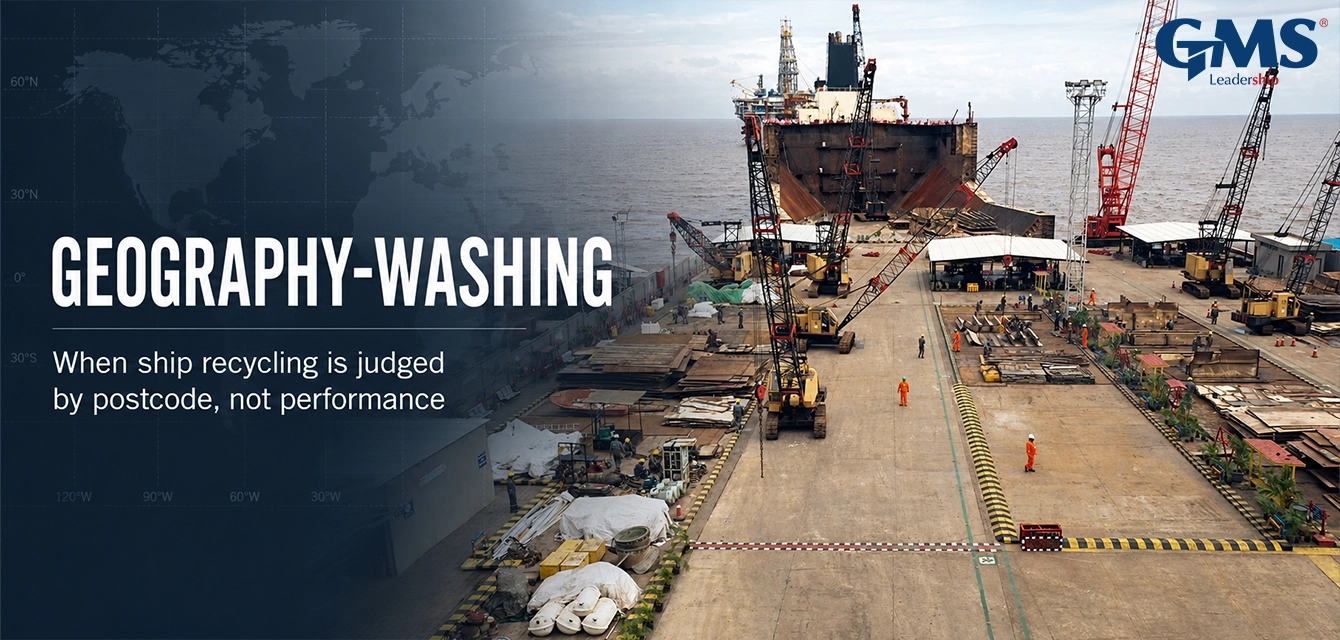
This is the heart of what the industry has come to recognise as geography-washing: the steady substitution of postcode for performance. The Platform’s objection is increasingly difficult to understand as a concern about method, safety, or measurable environmental outcome. It looks more and more like an objection to a map.
Steel cut in Ghent is a circular economy. The identical steel cut in Alang or Aliağa is a scandal. The chemistry is the same. The certification may be the same. The procedures may be audited. The downstream waste chain may be documented. The workers may be trained. The yard may have invested millions.
But the flag flying over the yard is wrong, and that, apparently, is enough.
It is worth being honest about who is in the room. EUROFER and Recycling Europe are not neutral guardians of worker safety. They are commercial interests and perfectly entitled to be so. They would very much like millions of tonnes of high-quality ship steel, currently recycled in South Asia and Turkey, to be redirected toward European mills and scrap processors.
There is nothing wrong with lobbying for one’s industry. It is done every day.
There is, however, something faintly comic about doing so under the banner of a “level playing field” while demanding that every major recycling method used outside Europe be outlawed. A level playing field is not one in which only your team is allowed to take the field.
The irony is rich. The same voices that speak of circular economy, resource efficiency, and industrial resilience now appear to suggest that ship recycling should be judged less by what happens inside a yard and more by where that yard happens to sit. This is not environmental policy. It is industrial protectionism dressed in a high-visibility vest.
Let us be clear about what we are not arguing.
No serious person in this sector claims that every yard is a green yard. No serious person claims that every practice is acceptable. There are excellent yards and poor yards in South Asia, in Turkey, in Europe, and in North America. Substandard practice is not a uniquely Asian habit. Nor does poor performance suddenly become respectable because it occurs under a Western postcode.
The correct response to a bad yard is to name it, audit it, sanction it, and hold it to account. The correct response is not to erase an entire geography, an entire method, or an entire decade of investment because it does not fit a campaign slogan.
And that progress is real.
The Hong Kong Convention entered into force on 26 June 2025. It is now binding international law, not a talking point, not an aspiration, not a voluntary brochure. More than a hundred yards have obtained Hong Kong Convention statements of compliance issued by IACS-member classification societies. Yards have invested heavily in impermeable floors, drainage systems, cranes, containment, worker training, emergency response, medical facilities, and downstream waste management.
This is not merely an industry talking point. Dr. Nikos Mikelis, one of the central technical voices in modern ship recycling regulation and Chairman of BIMCO’s Ship Recycling Alliance, has made the point clearly: the Hong Kong Convention was developed as a purpose-built regime for ship recycling, with a process that brings together the shipowner, the flag State, the recycling facility, and the recycling State before recycling can begin.
That matters. Because the debate is often presented as if the HKC is concerned only with what happens after a ship arrives at a yard. It is not. The HKC process requires the Ship Recycling Plan to be approved, the relevant hazardous materials to be accounted for, and the flag State to issue the International Ready for Recycling Certificate. That certificate is not a rubber stamp. It records the informed consent of the flag State and the recycling State in a form designed for the realities of international shipping. Without it, recycling cannot start.
This is the part that campaign slogans tend to skip.
This did not happen because NGOs issued press releases. It happened because regulators, shipowners, classification societies, cash buyers, and responsible recycling yards pushed the industry toward practical compliance.
The world has moved. The Platform remains standing at the dockside, waving an old banner and pretending the vessel has not sailed.
Of course, improvements must continue. Of course, compliance must be tested. Of course, certificates should not be ornamental. No credible industry participant should fear strict enforcement. In fact, serious recyclers should welcome it, because strong enforcement separates real yards from paper yards.
But enforcement is not the same thing as exclusion. Certification is not the same thing as geography. And environmental responsibility is not strengthened by pretending that Europe has a monopoly on virtue.
A blanket ban on beaching and landing may sound satisfying in a campaign office. It may look good in a headline. It may even please the steel lobby. But it is not a standard. It is an admission that one has stopped distinguishing between good and bad and decided that the distinction was never really the point.
If the goal is genuinely safe and environmentally sound ship recycling, the path is obvious: enforce the Hong Kong Convention, recognise certified yards wherever they operate, inspect rigorously, publish findings transparently, and prosecute the laggards wherever they are found.
That would be policy.
What the Platform is offering is something else. It is geography over evidence. It is campaigning over compliance. It is the familiar comfort of saying no, again and again, until every practical solution has been declared unacceptable.
The ship recycling industry does not need double standards. It also does not need double sermons from organisations that discover a new country to disapprove of every time the old argument starts to lose force.
A serious debate would ask which yards are safe, which yards are compliant, which yards are improving, and which yards should be removed from the market.
A less serious debate simply asks where the yard is located.
Unfortunately, the Platform seems to have chosen the second question and called it principle.
Contact Us
Ship Recycling TeamContact Us
Ship Recycling Team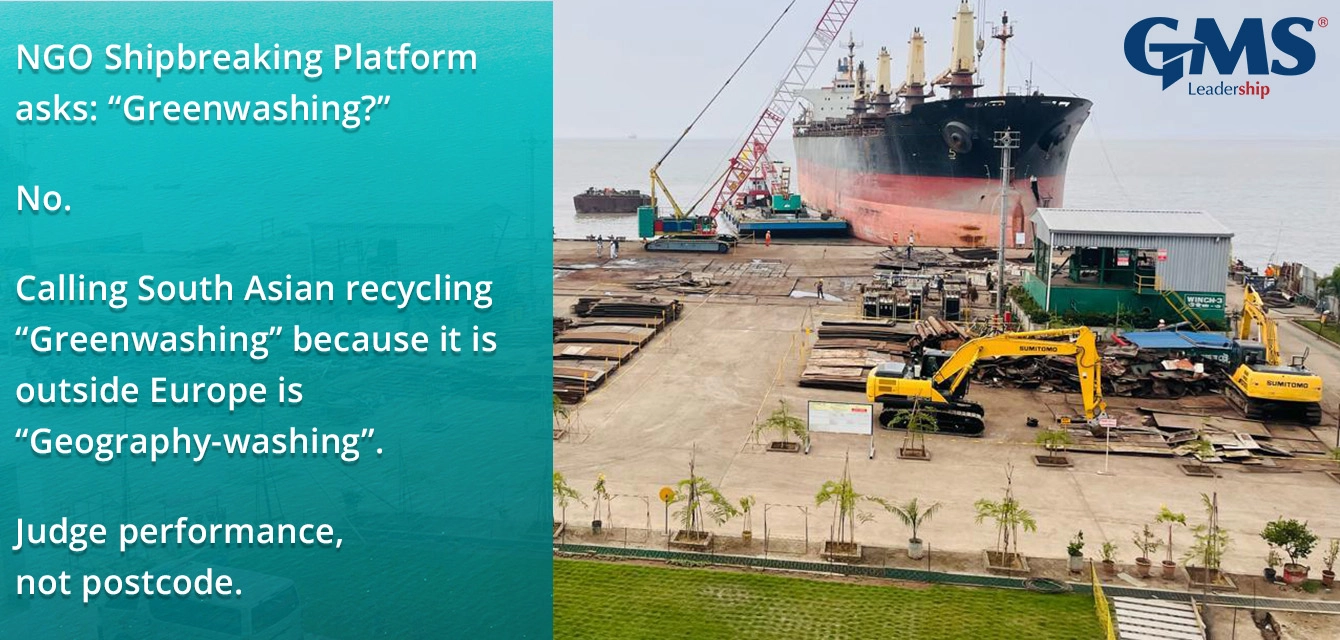
This article is part of an ongoing public exchange between NGO Shipbreaking Platform and GMS on ship recycling, circularity and ...
The recent decision to recycle the 1998-built chemical tanker NQ Zinnia in Denmark should be welcomed as a responsible end-of-life step. But it also gives the wider ship recycling industry a useful ...


Download GMS App