15 May 2026
This article is part of an ongoing public exchange between NGO Shipbreaking Platform and GMS on ship recycling, circularity and the role of South Asia.
For readers joining the discussion for the first time, the background is as follows:
NGO Shipbreaking Platform first published its article on the Circular Economy Act and ship recycling here:
https://shipbreakingplatform.org/the-circular-economy-act-risks-missing-the-boat-on-ship-recycling-and-true-circularity/
GMS responded with its article here:
https://www.gmsinc.net/article/thank-you-ngo-shipbreaking-platform-for-finally-seeing-the-light-but-the-numbers-point-to-south-asia-not-europe
NGO Shipbreaking Platform then responded to GMS through its LinkedIn post here:
https://www.linkedin.com/posts/shipbreaking-shiprecycling-circularity-share-7459932796199825408-kSqt
This article responds to that latest post and to the broader claims being made about end-of-life ships, circularity, South Asia and responsible recycling.
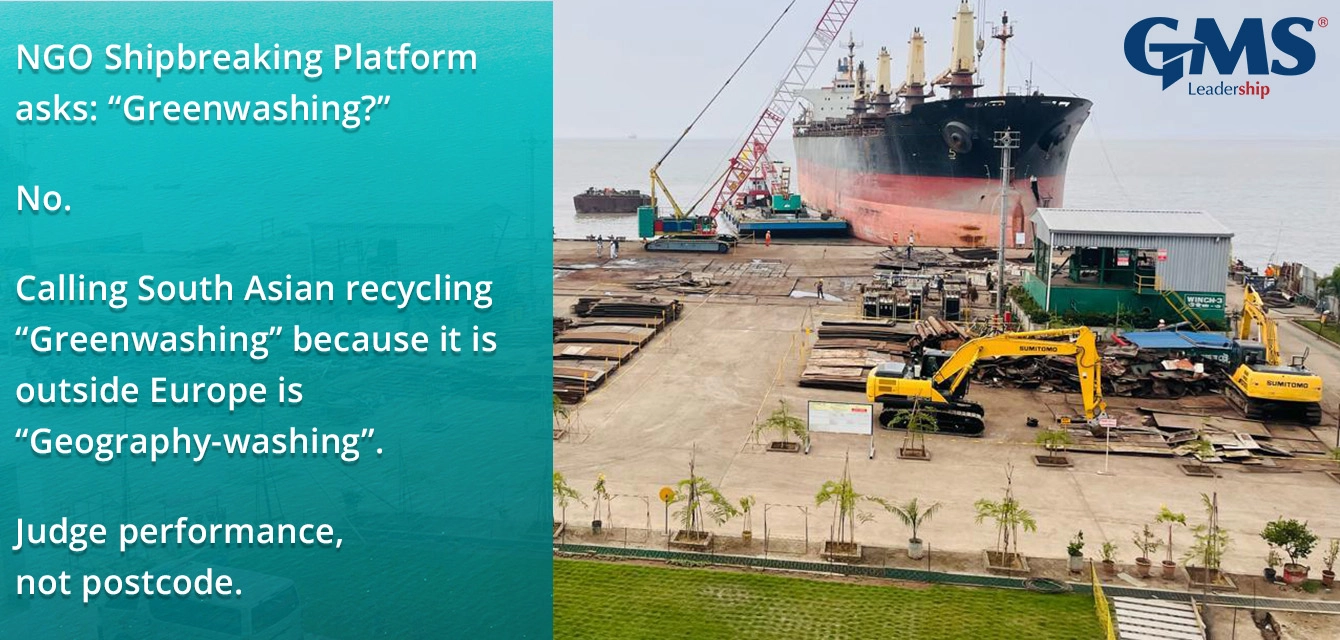
For years, the NGO Shipbreaking Platform has insisted that end-of-life ships are “waste.”
That classification has formed the foundation of its advocacy, legal arguments, and public campaigns. By defining ships primarily as hazardous waste, the Platform has continued to justify the application of the Basel Convention to the final voyage of end-of-life vessels bound for recycling yards, even after the Hong Kong Convention introduced the requirement for an International Ready for Recycling Certificate (IRRC) for that final voyage.
In doing so, the Platform has long sought to portray ship recycling as a disposal problem rather than as a circular economy solution.
That is why a recent statement from the Platform is so noteworthy:
“Yes, end-of-life ships are not waste. They are an untapped source of valuable steel…”
This is not a minor adjustment in language.
It is a fundamental acknowledgment of what ship recyclers, steelmakers, and maritime professionals have said for decades. End-of-life vessels are among the world’s most valuable industrial reservoirs of reusable materials. More than 97 percent of a vessel by weight can be reused or recycled.
In other words, a ship at the end of its service life is not merely “waste.” It is a large-scale circular economy asset.
To be clear, ships do contain hazardous materials that require careful handling. But the presence of hazardous components does not define the entire asset, any more than the battery in an electric vehicle defines the entire vehicle as hazardous waste.
The fact that the NGO Shipbreaking Platform has now publicly acknowledged the material value of end-of-life ships is a welcome development.
The next step is equally important: recognizing that responsible ship recycling should be judged by measurable performance, including worker safety, environmental controls, and waste traceability, not by geography alone.
For years, the ship recycling debate has often been presented as if sustainability can be determined by a map.
If a ship is recycled in Europe, the process is presumed virtuous.
If the same ship is recycled at a modern, independently verified facility in South Asia, it is often reduced to a single word: “beaching.”
Apparently, latitude and longitude have become more important than engineering controls, hazardous waste management, audited performance, and demonstrated compliance.
That would be amusing if it were not shaping public perception and policy.
Some commentary still portrays South Asian yards as though the last two decades never happened.
The facts tell another story.
Facilities in India, and some facilities in Bangladesh, have invested in impermeable floors and drainage systems, heavy lifting and material handling equipment, emergency response infrastructure, worker training, and formal hazardous waste storage and disposal systems.
Many of these improvements have been independently assessed by IACS classification societies and organizations, including ClassNK, IRS, Lloyd’s Register, and Bureau Veritas.
To continue describing the region as incapable of progress requires either outdated information or a remarkable commitment to preserving an old narrative.
The Hong Kong International Convention for the Safe and Environmentally Sound Recycling of Ships entered into force in June 2025.
It establishes globally harmonized requirements for inventories of hazardous materials, facility management systems, worker safety, emergency preparedness, and environmentally sound waste handling.
Notably, it does not state that compliance depends on continent.
The Convention asks a much more sensible question: does the facility meet the standard?
Advocacy has played an important role in improving ship recycling. The industry should recognize and appreciate that contribution from the Platform.
But credibility also requires acknowledging progress when it occurs.
When shortcomings are documented but verified improvements are consistently ignored, advocacy begins to resemble selective storytelling.
And when only one side of the story is presented to support a predetermined conclusion, it is reasonable to ask whether the communication itself meets the balance and transparency standards it demands from others.
Is that not a form of greenwashing?
The European Recycling Industries’ Confederation has warned that restricting exports of recycled steel would backfire environmentally and economically.
The principle is straightforward: recycled materials create environmental value wherever they are processed efficiently and responsibly. Europe’s net exports reflect low domestic demand rather than oversupply.
Circularity, it turns out, does not stop at Europe’s borders.
Rather than judging ship recycling facilities by geography, compare them using measurable indicators such as:
• Lost Time Injury Frequency Rate
• Hazardous waste traceability
• Environmental monitoring data
• Emergency preparedness
• Regulatory compliance history
• Material recovery efficiency
This approach may be less dramatic than slogans, but it has one decisive advantage: it is based on evidence.
The ship recycling industry has changed significantly.
The question is whether the narrative about it is prepared to change as well.
Acknowledging progress does not weaken advocacy. It strengthens credibility.
Responsible ship recycling should be judged by what an individual ship recycling facility does, not by where it is located.
Because geography is not an environmental management system.
Contact Us
Ship Recycling Team
Dr. Anand Hiremath is a leading voice in sustainable ship recycling, with a strong foundation in civil and environmental engineering and more than a decade of specialised expertise in safe and environmentally sound ship recycling.
He holds a master’s degree in Environmental Engineering from IIT Guwahati and earned his PhD from IIT Bombay, where his pioneering research on the Integrated Risk Assessment Framework for Best Practices in Ship Recycling contributed to advancing safety, environmental responsibility, and structured risk management within the industry.
As Chief Executive Officer of the Sustainable Ship and Offshore Recycling Program (SSORP), Dr. Hiremath plays a key role in strengthening responsible ship recycling practices across the sector. He works closely with recycling yards to support compliance with the Hong Kong Convention (HKC) for the safe and environmentally sound recycling of ships. Under his leadership, SSORP has overseen more than 100 Inventory of Hazardous Materials (IHM) surveys and successfully supported the recycling of over 130 end-of-life vessels.
His commitment to worker safety and practical capacity-building is reflected in more than 800 free safety awareness sessions conducted at recycling yards across the Indian subcontinent, benefiting over 13,000 workers. These initiatives have helped improve awareness, hazard recognition, and safe work practices at the yard level.
Beyond his operational leadership, Dr. Hiremath contributes to the development of the next generation of ship recycling professionals as Course Director for the Lloyd’s Maritime Academy Ship Recycling course in London. His global influence extends through his involvement in major international research and improvement initiatives, including the EU-funded DIVEST project and the Green Alang Initiative, both focused on improving environmental standards and sustainability in ship recycling.
Dr. Hiremath’s work has been published in leading international scientific journals, reinforcing his position as a thought leader in the field. He is also the author of The Green Handbook: A Practical Checklist to Monitor the Safe and Environmentally Sound Recycling of Ships, a practical industry resource for monitoring responsible ship recycling practices.
His professional credentials include Lead Auditor certifications for ISO 45001 and ISO 9001, certification as a Hazmat expert, Social Auditor, Responsible Steel Auditor, and sustainability practitioner.
With his combination of technical expertise, field experience, academic contribution, and commitment to worker safety and environmental protection, Dr. Anand Hiremath remains at the forefront of the global movement toward safer, greener, and more sustainable ship recycling.
Contact Us
Ship Recycling Team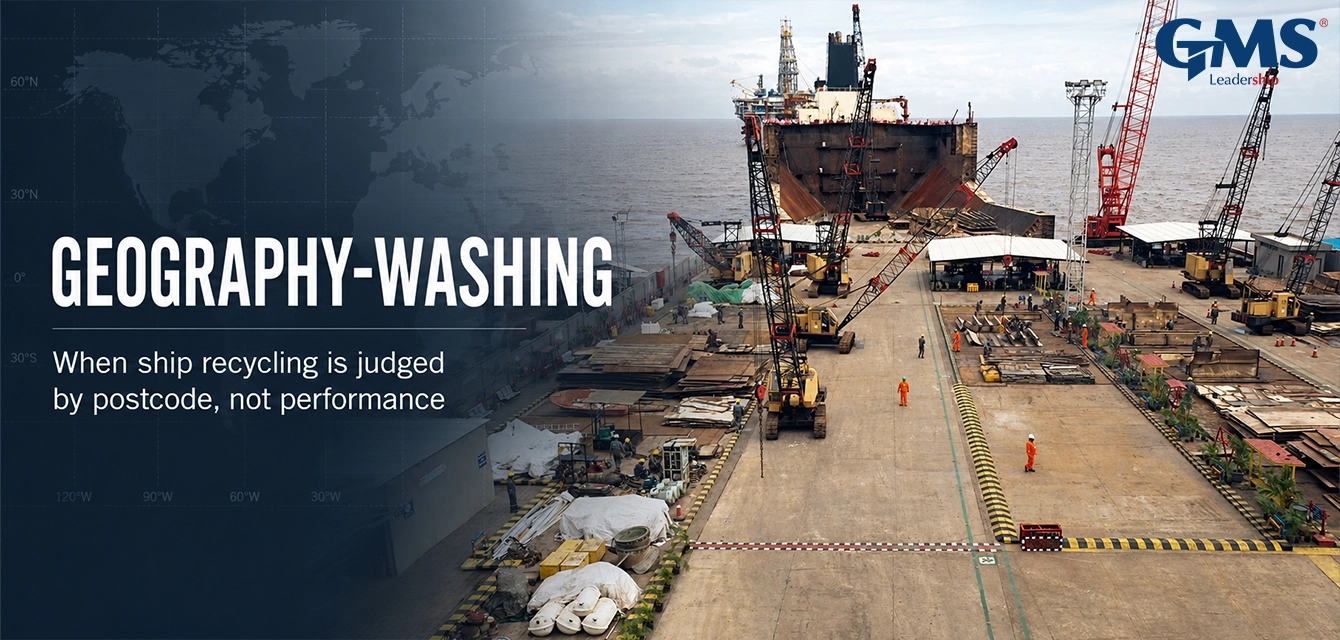
There is a certain comfort in consistency, and the NGO Shipbreaking Platform offers it in abundance. Whatever the question, ...
The recent decision to recycle the 1998-built chemical tanker NQ Zinnia in Denmark should be welcomed as a responsible end-of-life step. But it also gives the wider ship recycling industry a useful ...


Download GMS App