23 Apr 2026
The European Union has long positioned itself at the forefront of responsible ship recycling. The intent behind the EU Ship Recycling Regulation (EUSRR) is clear and commendable: to ensure that end-of-life vessels are dismantled in a manner that protects both human health and the environment.
The recently issued draft guidance for third-country yard inclusion continues in that same spirit. It seeks to clarify expectations, strengthen oversight, and ensure consistency in how facilities are assessed. These are important objectives, and the industry broadly supports the direction of travel.
However, as with any regulatory framework that operates across jurisdictions, the effectiveness of the policy will ultimately be determined not only by the standards it sets, but by the level of participation it achieves.
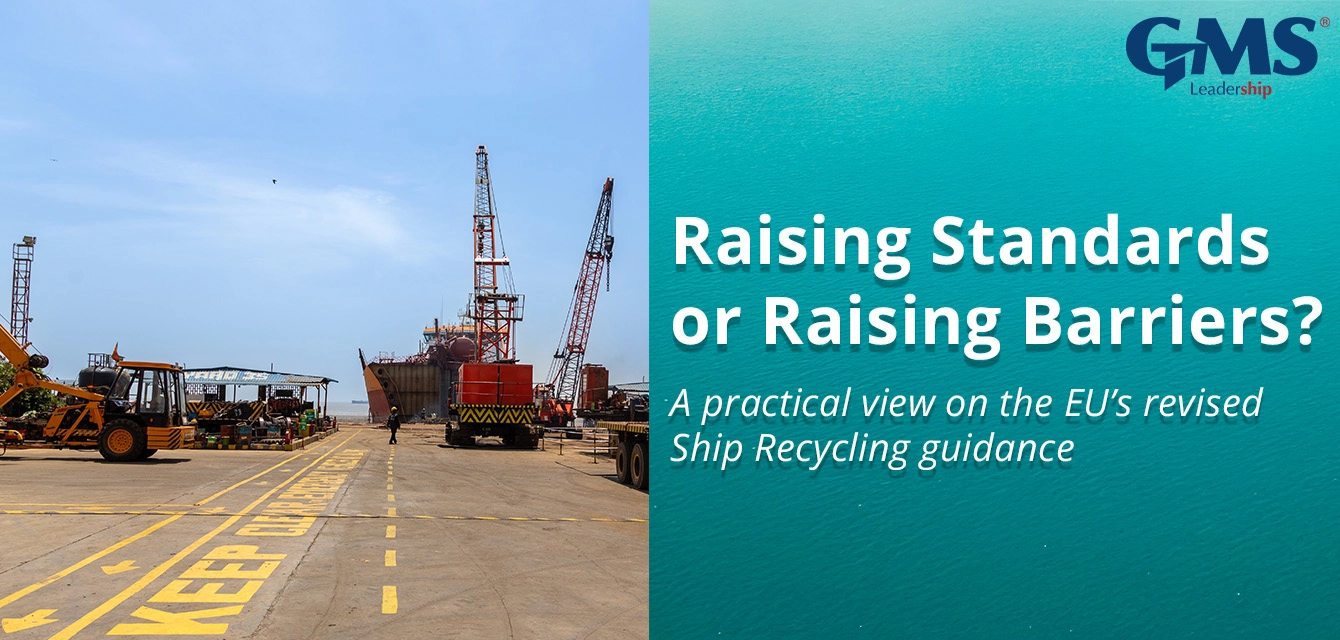
At first glance, the revised guidance appears significantly more stringent than previous interpretations. While presented as clarification, the document introduces a level of detail and expectation that, in practice, raises the threshold for entry in a meaningful way, particularly for major recycling hubs such as Alang.
This distinction matters.
The core premise of the EUSRR has always been that facilities outside the EU can be included in the EU List, provided they meet equivalent standards. In principle, this creates a pathway for global alignment.
In practice, the revised draft risks shifting that pathway into a narrow corridor.
Several elements contribute to this shift:
Expanded interpretation of infrastructure requirements, particularly around impermeable flooring, drainage systems, and handling areas. For instance, the scope now extends beyond primary cutting zones to include handling, sorting, and movement areas, significantly widening the physical footprint required for compliance.
More prescriptive environmental monitoring frameworks. These now require defined methodologies, station mapping, and year-on-year comparability, often involving accredited laboratory testing, introducing a level of operational and administrative intensity not previously required.
Increased emphasis on downstream waste management being “broadly equivalent” to EU standards. This places an implicit obligation on yards to ensure compliance across external value chains that are often outside their direct control.
A heavier documentation and verification burden, including expectations around the independence and role of third-party verifiers.
A more complex inspection and review structure, including the possibility of unannounced inspections and cumulative deficiency assessments.
Individually, each of these elements can be justified. Collectively, they create a compliance environment that may prove difficult to access, even for yards that have already invested significantly in upgrades and alignment with international conventions.
Facilities in Alang, for example, have undergone substantial transformation over the past decade. Many yards have invested in infrastructure improvements, safety systems, environmental controls, and Hong Kong Convention compliance.
The question is no longer whether progress has been made. It clearly has.
The question now is whether the revised framework recognises that progress as a foundation to build upon, or whether it resets the baseline to a level that is operationally difficult to achieve within a reasonable timeframe.
One area where this becomes particularly evident is in the interpretation of environmental control systems. Requirements around impermeable surfaces, drainage collection, and water treatment are expanded to cover a broader range of activities and areas. While technically sound, the practical application of these requirements in intertidal operating environments introduces engineering and operational challenges that are not easily reconciled with existing yard layouts.
Similarly, the expectation that downstream waste facilities operate to standards broadly equivalent to those in the EU raises questions of jurisdictional reach. Ship recycling yards do not operate in isolation, and their ability to control or certify external waste ecosystems is inherently limited. In effect, compliance expectations begin to extend beyond the facility boundary into national waste ecosystems, where alignment is neither uniform nor fully verifiable by the yard itself.
These are not arguments against higher standards. They are reflections of operational realities that must be accounted for if the objective is to bring more facilities into a regulated framework.
The most important consideration, however, lies not in the technical details, but in how market participants respond.
Shipowners operate in a commercial environment. End-of-life decisions are influenced by freight markets, steel prices, regulatory exposure, and timing. In such conditions, owners are unlikely to delay decisions while navigating uncertain or prolonged approval processes.
If inclusion on the EU List is perceived as complex, unpredictable, or out of reach, the likely outcome is not a pause in recycling activity. It is a shift in where that activity takes place.
This is the central risk.
By raising the entry threshold without a clearly defined transition pathway, the framework may limit participation rather than expand it. In doing so, it risks reducing the number of approved facilities available to the market.
The result is not reduced recycling, but redirected recycling, often into channels where regulatory oversight is less visible. This ultimately diminishes the very influence the regulation seeks to extend.
There is an alternative path that could better align regulatory ambition with market behaviour.
A phased inclusion model would allow a limited number of demonstrably compliant yards to enter the EU List based on current capabilities, subject to clearly defined improvement milestones over time. A phased approach would recognise existing compliance efforts as a starting point, rather than requiring full alignment at the point of entry.
This would:
Encourage participation by providing a visible and achievable entry point
Maintain regulatory oversight while improvements continue
Create real-world examples of compliance outside the EU
Allow standards to evolve in parallel with operational adaptation
Introduce measurable, time-bound improvement milestones aligned with infrastructure and monitoring upgrades
Such an approach would not dilute standards. It would sequence them.
It would recognise that transformation in industrial environments is a process, not an event, and that sustained improvement is often best achieved through engagement rather than exclusion.
The EU has an opportunity to shape global ship recycling practices in a meaningful way. That influence, however, depends on participation.
If the regulatory framework becomes too difficult to access, it risks creating a system that is robust in design but limited in reach. Conversely, a system that combines high standards with practical pathways for inclusion can extend its impact far beyond its immediate jurisdiction.
The current draft guidance reflects a strong commitment to environmental and safety outcomes. The next step is to ensure that it also supports practical adoption.
Regulation in complex, global industries is always a balance between ambition and applicability.
The revised guidance represents an important evolution of the EUSRR framework. It also presents an opportunity to reflect on how that framework interacts with the realities of ship recycling markets.
If the objective is to improve standards globally, then the pathway to participation must be as carefully considered as the standards themselves.
Because in the end, the success of any regulatory system is not measured solely by the level it sets, but by how many are able, and willing, to meet it.
Without that balance, there is a real risk that regulatory intent outpaces market participation.
Contact Us
Ship Recycling Team
Dr. Anand Hiremath is a leading voice in sustainable ship recycling, with a strong foundation in civil and environmental engineering and more than a decade of specialised expertise in safe and environmentally sound ship recycling.
He holds a master’s degree in Environmental Engineering from IIT Guwahati and earned his PhD from IIT Bombay, where his pioneering research on the Integrated Risk Assessment Framework for Best Practices in Ship Recycling contributed to advancing safety, environmental responsibility, and structured risk management within the industry.
As Chief Executive Officer of the Sustainable Ship and Offshore Recycling Program (SSORP), Dr. Hiremath plays a key role in strengthening responsible ship recycling practices across the sector. He works closely with recycling yards to support compliance with the Hong Kong Convention (HKC) for the safe and environmentally sound recycling of ships. Under his leadership, SSORP has overseen more than 100 Inventory of Hazardous Materials (IHM) surveys and successfully supported the recycling of over 130 end-of-life vessels.
His commitment to worker safety and practical capacity-building is reflected in more than 800 free safety awareness sessions conducted at recycling yards across the Indian subcontinent, benefiting over 13,000 workers. These initiatives have helped improve awareness, hazard recognition, and safe work practices at the yard level.
Beyond his operational leadership, Dr. Hiremath contributes to the development of the next generation of ship recycling professionals as Course Director for the Lloyd’s Maritime Academy Ship Recycling course in London. His global influence extends through his involvement in major international research and improvement initiatives, including the EU-funded DIVEST project and the Green Alang Initiative, both focused on improving environmental standards and sustainability in ship recycling.
Dr. Hiremath’s work has been published in leading international scientific journals, reinforcing his position as a thought leader in the field. He is also the author of The Green Handbook: A Practical Checklist to Monitor the Safe and Environmentally Sound Recycling of Ships, a practical industry resource for monitoring responsible ship recycling practices.
His professional credentials include Lead Auditor certifications for ISO 45001 and ISO 9001, certification as a Hazmat expert, Social Auditor, Responsible Steel Auditor, and sustainability practitioner.
With his combination of technical expertise, field experience, academic contribution, and commitment to worker safety and environmental protection, Dr. Anand Hiremath remains at the forefront of the global movement toward safer, greener, and more sustainable ship recycling.
Contact Us
Ship Recycling Team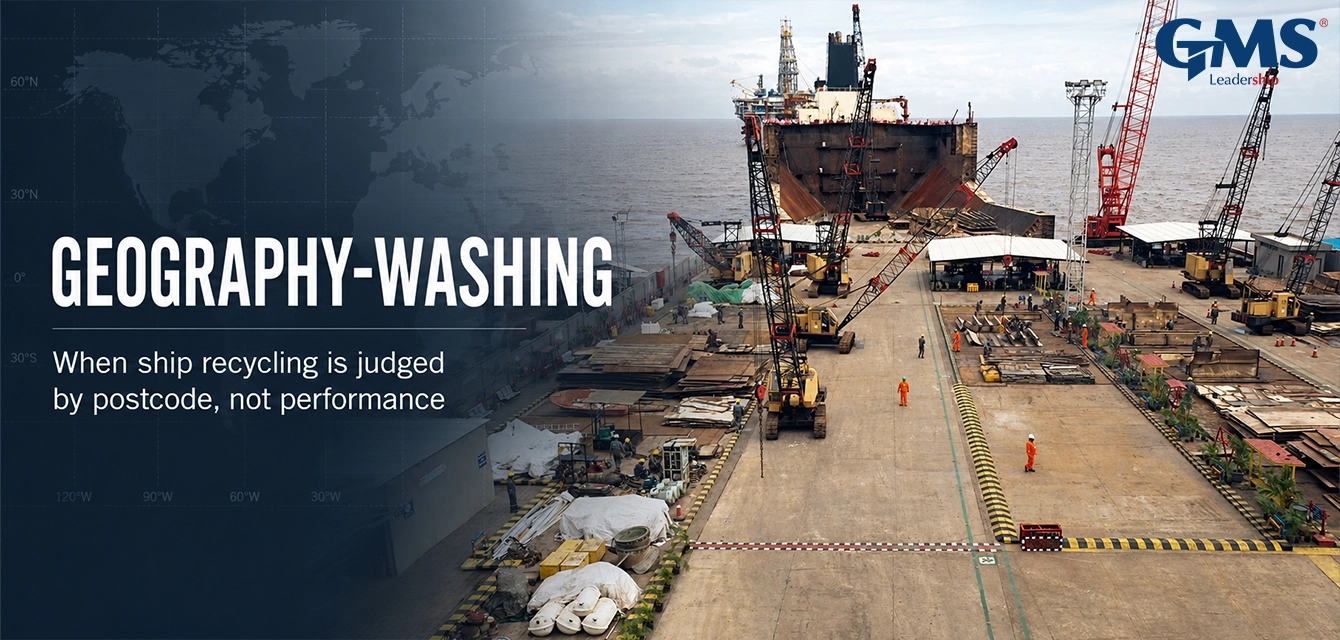
There is a certain comfort in consistency, and the NGO Shipbreaking Platform offers it in abundance. Whatever the question, ...
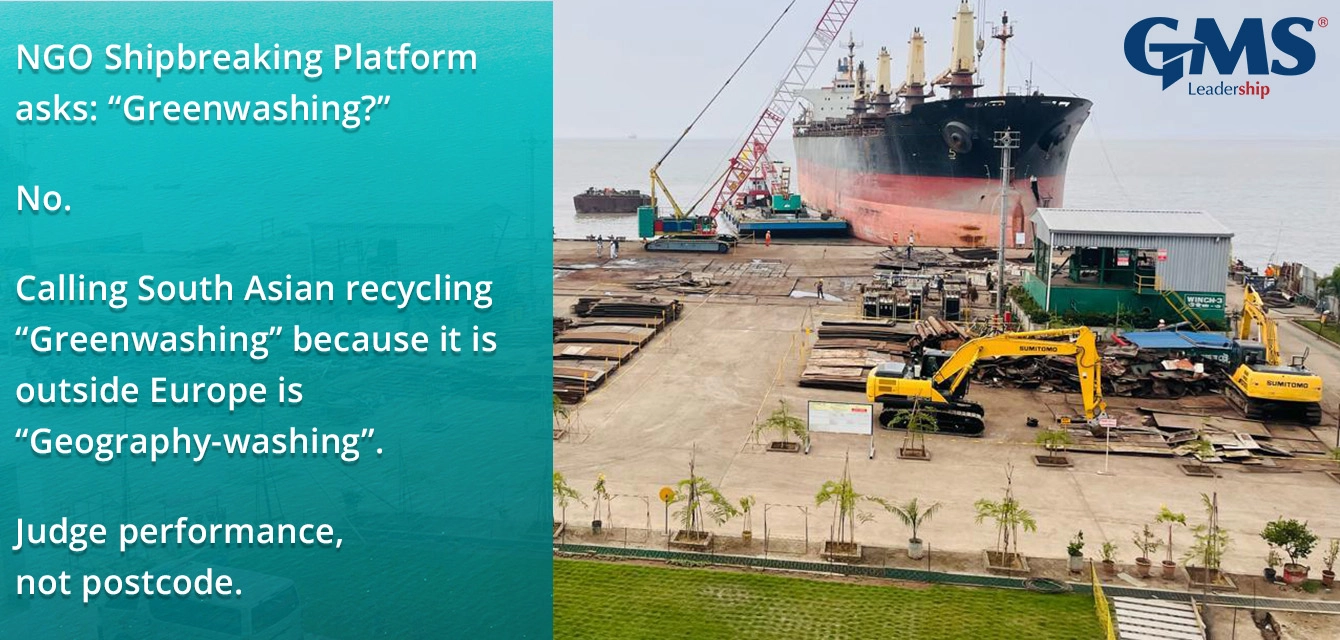
This article is part of an ongoing public exchange between NGO Shipbreaking Platform and GMS on ship recycling, circularity and ...


Download GMS App