19 Jun 2026




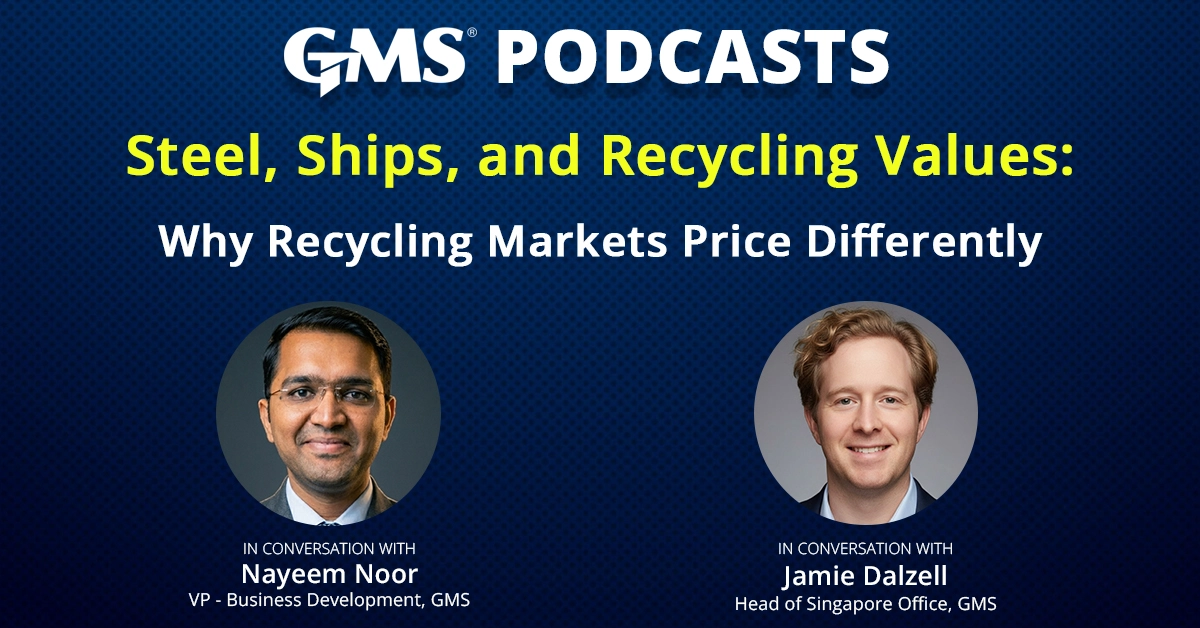
In this episode of GMS Podcasts, Nayeem Noor, VP, Business Development and Communications at GMS, speaks with Jamie Dalzell, Head of the GMS Singapore Office, in Episode 2 of the series Steel, Ships, and Recycling Values.
Following Episode 1’s discussion on why steel prices sit at the centre of ship recycling offers, Episode 2 examines why recycling prices differ across Bangladesh, Pakistan, India, and Turkey, even when all major recycling destinations are influenced by the same global steel fundamentals.
The conversation explains why steel value alone does not determine the best recycling destination. Each market converts steel prices into offers through its own commercial filter, including domestic steel demand, currency movement, banking support, LC availability, yard appetite, buyer depth, compliance capacity, downstream liquidity, geography, regulation, and execution risk.
Bangladesh remains highly sensitive to domestic steel demand and banking support. When local steel demand is strong and letters of credit are moving, Chattogram buyers can become highly competitive, particularly for larger LDT units such as bulkers and tankers. However, demand must be supported by executable finance, local liquidity, and currency stability.
Pakistan can become competitive when firm steel pricing aligns with a stable Rupee. Gadani buyers may surprise the market when local steel values and currency conditions support stronger dollar-equivalent bids. However, buyer depth, financing, compliance progress, and vessel suitability remain important considerations.
India continues to offer one of the deepest and most diversified ship recycling markets. Alang may not always deliver the highest headline price, but it provides broad yard capacity, resale depth, specialist buyers, non-ferrous and machinery markets, and significant HKC-compliant infrastructure. For HKC-focused owners, specialist tonnage, offshore units, and vessels with valuable equipment, India often offers flexibility, reliability, and execution confidence.
Turkey is different again. Aliaga is linked to its own domestic steel and scrap market, the Turkish Lira, and regional demand, but it is also shaped by geography, regulation, and owner requirements. For vessels connected to European owners or EU regulatory considerations, Turkey may be commercially acceptable even when its headline price is below South Asian levels.
A key point in the episode is that the highest recycling price is not always the best recycling outcome. Shipowners, brokers, financiers, and maritime professionals must consider the full risk-adjusted transaction: price, buyer quality, finance, delivery terms, compliance requirements, timing, and execution certainty.
The discussion also highlights the role of timing. A destination may look strong on paper, but holidays, tides, monsoon conditions, beaching windows, delivery logistics, or regulatory deadlines can affect whether a bid is actually executable. In ship recycling, market strength only matters if the vessel can reach the right buyer at the right time.
This episode is useful for shipowners, operators, brokers, cash buyers, recyclers, financiers, chartering teams, maritime lawyers, technical managers, ESG teams, and anyone following ship recycling markets, steel prices, demolition values, regional spreads, and vessel retirement decisions.
Steel, Ships, and Recycling Values is a three-part GMS Podcasts series examining how steel markets influence ship recycling prices and owner decision-making.
Episode 1 focused on why steel prices drive ship recycling offers. Episode 2 explains why Bangladesh, Pakistan, India, and Turkey can price the same vessel differently. Episode 3 will examine why recycling offers can move quickly and what shipowners should watch before deciding whether to recycle now or wait.
As the world’s largest cash buyer of ships and offshore assets for recycling, GMS continues to provide market insight, commercial guidance, and responsible recycling solutions for shipowners across the global maritime industry.


Download GMS App