04 Feb 2026
After more than twenty five years in the ship recycling industry, one thing is crystal clear to me. The final voyage of a vessel is rarely about price alone. It is about bringing order to commercial chaos and mitigating risk through planning, foresight, and timely execution of what has been agreed.
From the outside, end of life transactions can appear simple. A vessel is sold, a delivery location is agreed, and a price is fixed. What is rarely visible is the work required to move an unknown, ageing, damaged, or idle asset safely from where it lies to its final destination.
At GMS, operations exist to bring structure to that uncertainty. Our role is to ensure that every project, regardless of complexity, is completed safely, transparently, and in full compliance with contractual commitments.
The term “as is where is” is widely used in our industry, but it is often misunderstood. For shipowners, it offers a clear advantage. Once the vessel is sold, apart from commercial risks, the technical risks associated with moving that vessel transfer to the buyer.
These risks are substantial and include technical failures, weather exposure, crew safety, regulatory approvals, insurance acceptance, and environmental responsibilities.
For a cash buyer, accepting these risks requires more than commercial confidence. It requires proven operational capability.
At GMS, we ask extensive technical and operational questions before committing to a transaction, rather than after the fact. This is not done to delay the process, but to ensure that once a memorandum of agreement is signed, it is honoured in full. In our history, we have never walked away from a contract because circumstances became difficult or turned out contrary to expectations. This principle is central to our reputation and legacy.
No two vessel takeovers are ever the same. In many cases, our teams board ships that are in blackout, technically compromised, or supported by crews who are uncertain and under pressure.
Often, only two or three people are permitted on board to assess the vessel. Within a very limited timeframe, they must determine technical condition, safety risks, watertight integrity, and the feasibility of onward movement. This assessment is usually completed before final payment, which means the responsibility carried by these teams is significant. Once this decision is made, there is no turning back.
For vessels proceeding under their own power, the focus is on restoring technical systems, safety systems and ensuring reliability. For towage cases, complexity increases further. Weather patterns, sea state, location, underwriter requirements, and warranty surveyor conditions vary widely. What is acceptable in one region may not be permitted in another.
This is why hands on experience matters. Our operational teams are built around seafarers who understand how ships behave at sea, not only on paper, but also the psychology of those who sail these assets.
A vessel declared a constructive total loss is often assumed to be beyond recovery. In reality, a CTL declaration is an insurance decision, not always a technical one.
I recall a cruise vessel in the Bahamas that struck rocks and suffered severe engine room flooding up to the generator level. The initial plan was towage. However, weather conditions and insurer concerns altered the risk profile, and a decision was made to fully restore the engine room. Cabling was replaced, machinery was cleaned and tested, and electrical continuity was verified throughout the vessel.
After extensive repairs and significant investment, the vessel proceeded safely under its own power to the recycling destination. Although declared a total loss, it was technically capable of a controlled and compliant voyage.
In another case, a tanker that had been idle off the West African coast for more than a decade was lying in complete darkness. Systems were restored progressively from the bottom up, including the inert gas system and essential safety equipment. The vessel later steamed under its own power to the subcontinent, surprising even the seller.
These outcomes are not the result of optimism. They are the result of disciplined planning and experienced execution.
Some of the most demanding projects involve vessels affected by fire, explosion, or collision. In certain cases, portions of the hull may be missing or structurally weakened. This has not deterred us from undertaking delivery projects.
Risk assessment is where operational expertise becomes critical. Our teams evaluate whether watertight integrity can be restored. If not, naval architects are engaged to assess stability, longitudinal strength, and ballast strategies suitable for expected sea conditions.
We have handled loaded vessels that suffered collision damage, arranged safe cargo discharge, prepared hulls for towage, and delivered without incident. In cases where vessels suffered extensive explosion damage and deck structures were compromised, structural calculations were carried out to confirm whether ocean passage was feasible. Appropriate measures were then implemented to move the vessel safely from the delivery location to the recycling yard.
Safety is never compromised for cost. If additional expenditure is required to protect life, the environment, or the vessel, it is approved and executed. This is not a slogan. It is how GMS operates.
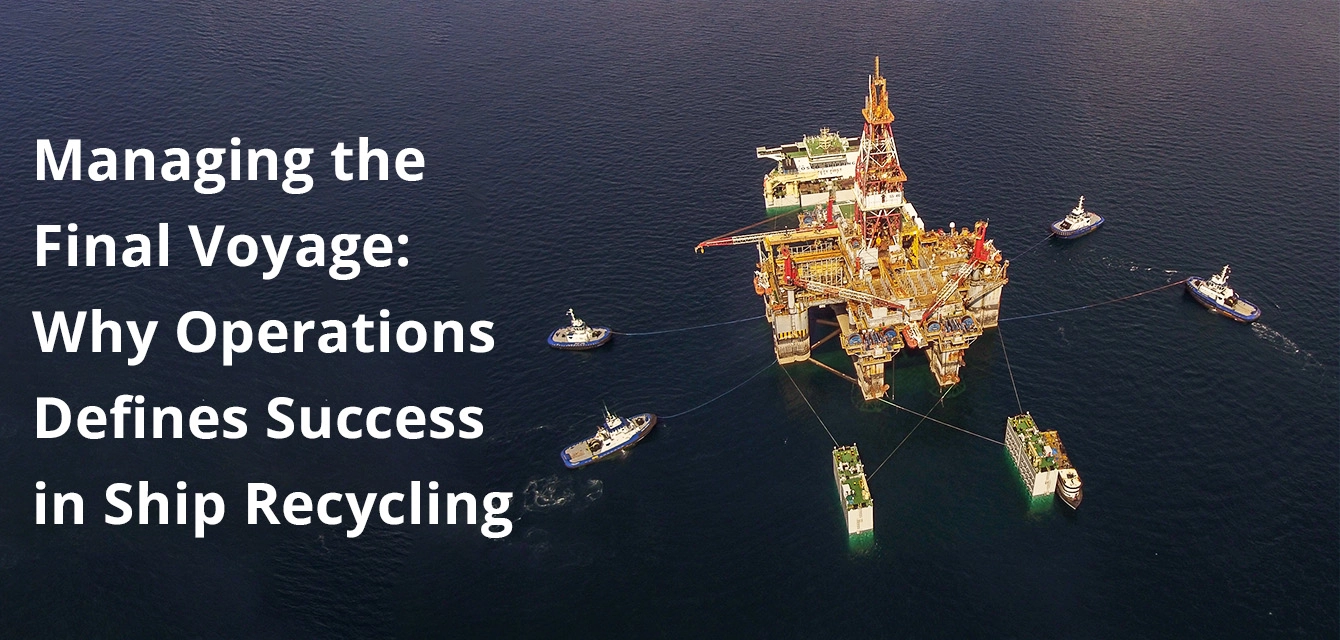
Offshore assets introduce a different category of risk. FPSOs are generally ship shaped, but semi submersibles, jack up rigs, and older offshore structures behave very differently at sea.
Three leg semi submersibles require particular attention due to their stability characteristics. Jack up rigs, with their flat bottoms, are treated cautiously by underwriters and require extensive preparation. Age related steel wastage, flare mast security, and emergency response planning all play a critical role in approval.
One defining project was the towage of a semi submersible from Brazil on a voyage lasting more than six months. At the time, offshore unit recycling in the subcontinent was unproven. Insurance support was unavailable, and risk acceptance was low. GMS assumed responsibility for the voyage, including underwriting elements internally. During passage, tow lines failed, the unit drifted for several days, and severe weather caused loss of visual contact. Through coordination, recovery, and persistence, the unit was delivered successfully.
Another milestone was achieving acceptance for jack up rig beaching upriver in Chittagong. Coverage was secured until arrival at port limits, with the final stage underwritten internally through careful planning using additional tugs and tidal windows. Following successful execution, industry confidence increased and future approvals became easier.
These projects raised operational standards across the sector.
Environmental protection does not begin at the recycling yard. It begins the moment a vessel is taken over.
At GMS, we follow IMO, MARPOL, and Hong Kong Convention requirements strictly. These standards exist because safe and compliant execution is achievable with proper planning. Associated costs are budgeted from the outset, and corners are not cut to reduce expenditure.
Protecting the environment protects lives, coastal communities, fishing activity, and the reputations of all parties involved. This approach safeguards not only GMS, but also the legacy of the shipowner.
Responsible recycling is no longer optional. It is an essential part of the maritime circular economy. Recovered steel returns to production and supports broader industrial demand.
As ESG expectations increase, shipowners and offshore operators are seeking partners who can demonstrate traceability, transparency, and consistent operational discipline. GMS continues to invest in cleaner processes, digital tracking systems, and compliance frameworks to meet these expectations.
Experience, however, cannot be built quickly. It is earned through decades of complex voyages, difficult decisions, and responsibility taken when conditions are at their worst.
When preparing a vessel for its final voyage, choose your partner carefully. Price is important, but it is not the full cost of the decision.
The final voyage is where reputations are tested. Anyone can quote a number. Not everyone can deliver safely at that number.
At GMS, our commitment is simple. We deliver what we promise. We do so with discipline, transparency, and respect for safety and the environment. That is how trust is built, and that is how it is maintained.
Contact Us
Ship Recycling Team
Captain Yogesh Rehani is Head of Operations at GMS, where he leads the execution of complex end of life vessel and offshore asset projects across multiple jurisdictions. His role sits at the intersection of operational risk management, regulatory compliance, and safe delivery, making him directly responsible for some of the most technically demanding voyages in the maritime sector.
A Master Mariner by training, Captain Rehani began his seagoing career after graduating from the Merchant Marine Training Institute T.S. Rajendra. He completed his initial deck training with The Shipping Corporation of India and later sailed with Norwegian, Brazilian, and American shipowners, gaining extensive international experience across a wide range of vessel types.
He holds a Degree in Nautical Sciences and a Master Mariner’s licence from RMIT University, Melbourne, and served in command as a ship captain before transitioning ashore.
Since moving ashore in 2000 and entering the ship recycling industry, Captain Rehani has been deeply involved in operational execution, drawing on more than 19 years of seagoing experience. At GMS, he oversees high risk and non standard projects requiring disciplined planning, technical judgement, and strict adherence to international maritime and environmental standards.
Contact Us
Ship Recycling Team
India is home to one of the world’s most significant ship recycling clusters. Located along the coast of Gujarat, Alang plays a critical role in the maritime industry. To assess the current state ...

Technical management for trading vessels has evolved over the years and ship owners prefer to manage their vessels either themselves through their in-house technical team or through a third-party ship ...


Download GMS App